
Yuanzhangxiao
Academic portfolio of Yuanzhang Xiao, associate professor researching AI-driven decision-making and optimization
 GitHub
What it is
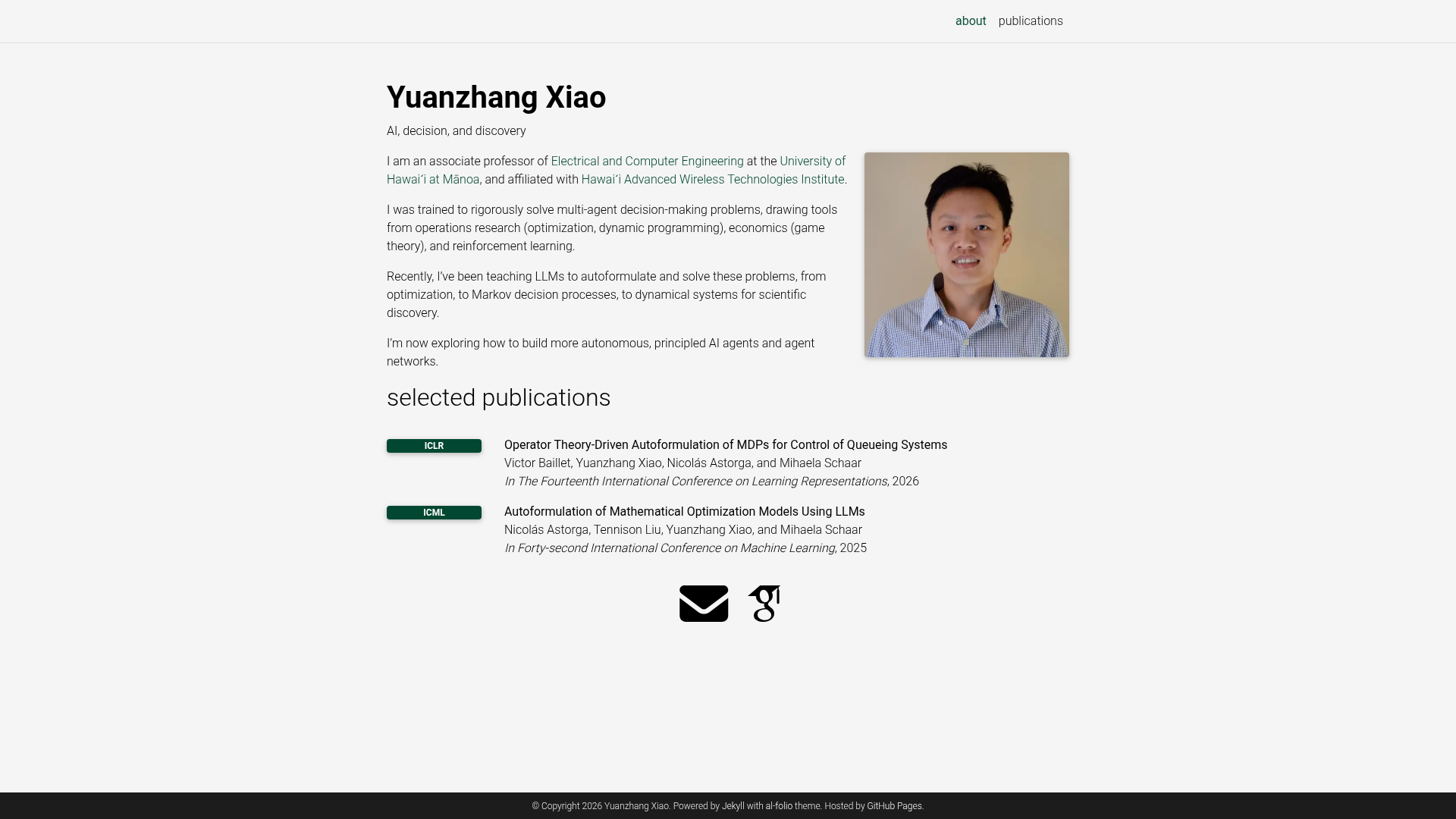
This site serves as the professional academic portfolio of Yuanzhang Xiao, an associate professor of Electrical and Computer Engineering at the University of Hawaiʻi at Mānoa. The website showcases his research expertise in multi-agent decision-making, drawing from operations research, game theory, and reinforcement learning to solve complex optimization problems.
The portfolio highlights recent work on teaching large language models to automatically formulate and solve mathematical optimization models, Markov decision processes, and dynamical systems for scientific discovery. Selected publications from top-tier venues including ICLR 2026 and ICML 2025 demonstrate contributions to operator theory-driven autoformulation of MDPs for queueing control and LLM-based autoformulation of mathematical optimization models.
Visitors can explore the professor's research trajectory from rigorous multi-agent systems to cutting-edge AI agent networks. The site provides access to publication records and insights into current research directions focused on building more autonomous and principled AI agents. This makes it a valuable resource for researchers, students, and industry professionals interested in the intersection of AI, operations research, and control theory.
Built with Jekyll using the al-folio theme and hosted on GitHub Pages, the site follows academic web standards with clean navigation between about, publications, and research sections. The platform serves as both a professional showcase and a knowledge hub for those tracking advances in AI-driven decision-making and automated problem formulation.
For academics and practitioners in machine learning, optimization, and wireless technologies, this portfolio offers a window into state-of-the-art research on LLM-augmented mathematical modeling and autonomous agent design.
This description was generated by AI from the site's public content and may contain errors.
What you can do there
- View academic profile and research expertise
- Browse selected publications from top conferences
- Learn about LLM-based autoformulation research
- Explore multi-agent decision-making work
- Access information on current research directions
Who it's for
Researchers, students, and professionals in AI, optimization, and control theory
Frequently asked questions about yuanzhangxiao.github.io
›What is Yuanzhang Xiao's current academic position?
Yuanzhang Xiao is an associate professor of Electrical and Computer Engineering at the University of Hawaiʻi at Mānoa and affiliated with the Hawaiʻi Advanced Wireless Technologies Institute.
›What are the main research areas covered on this site?
The site covers multi-agent decision-making, operations research, game theory, reinforcement learning, and recent work on LLM-based autoformulation of optimization models and Markov decision processes.
›Which recent publications are featured on the portfolio?
Featured publications include an ICLR 2026 paper on operator theory-driven autoformulation of MDPs for queueing control and an ICML 2025 paper on autoformulation of mathematical optimization models using LLMs.
›How can I access the full publication list?
The site includes a publications section accessible through the navigation menu where visitors can browse the complete list of research papers and conference proceedings.
›What is the focus of current research projects?
Current research explores building more autonomous and principled AI agents and agent networks, with emphasis on teaching LLMs to autoformulate and solve complex decision-making problems.
›Is this website regularly updated with new research?
The site features publications from 2025 and 2026, indicating active maintenance and updates as new research becomes available.
›Can students or collaborators contact the professor through this site?
The site serves as a professional academic profile; contact information would typically be available through the university directory or the about section for collaboration inquiries.