
Tempo
Open-source Python SDK for building and deploying machine learning inference pipelines locally and to Kubernetes.
 ReadtheDocs
What it is
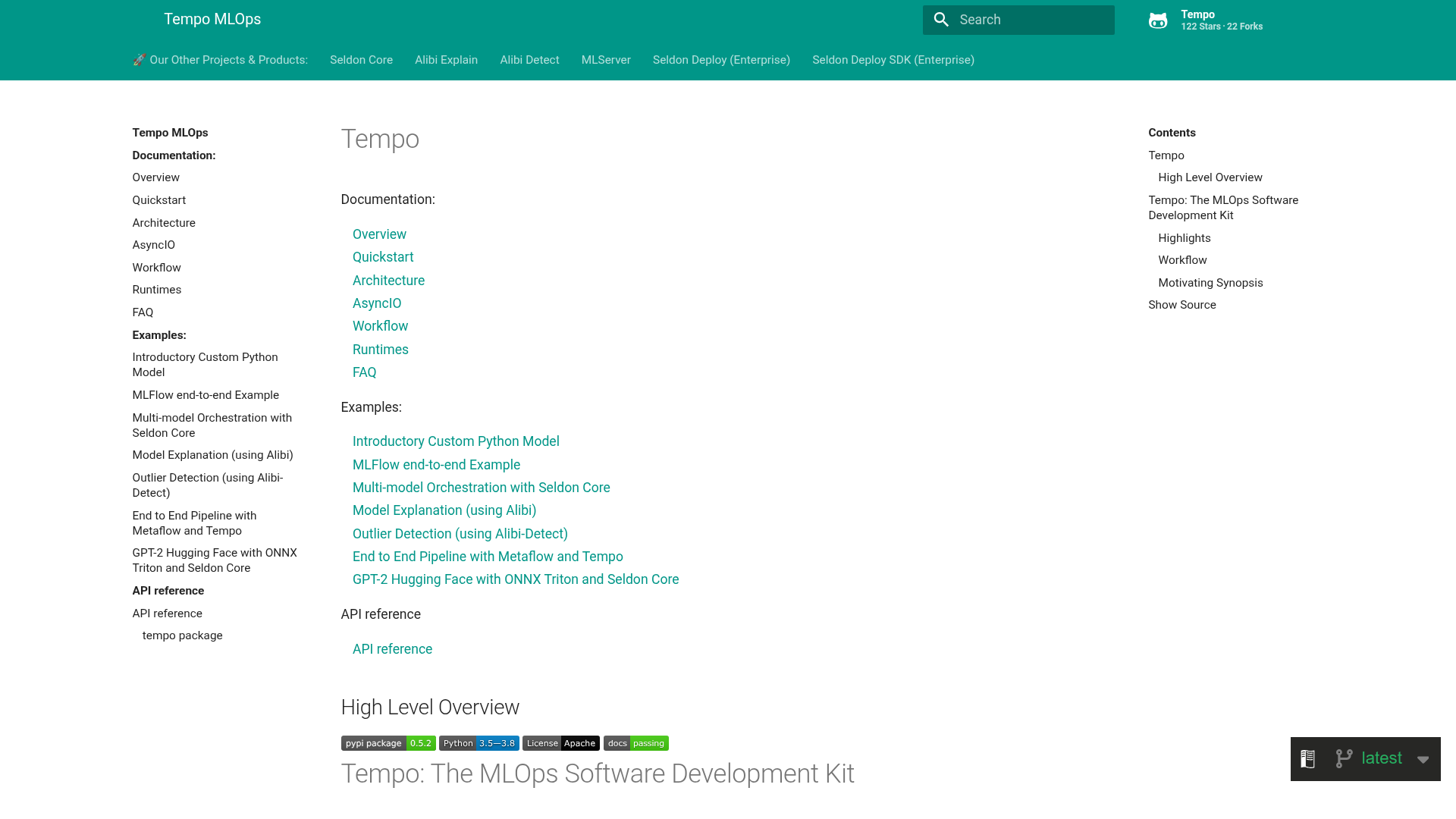
Tempo is an open-source MLOps software development kit created by Seldon Technologies that enables data scientists to develop, test, and deploy machine learning inference pipelines. The SDK provides a unified interface for packaging trained model artifacts into optimized server runtimes supporting frameworks such as TensorFlow, PyTorch, scikit-learn, and XGBoost. Users can compose custom business logic and orchestration steps into production-ready inference pipelines that include model explainers, outlier detectors, and other preprocessing components.
The development workflow emphasizes local iteration. Data scientists can write pipeline code using familiar Python constructs, run unit tests locally, and validate behavior with Docker containers that mirror production runtimes. When ready, the same artifacts can be pushed to remote object storage and deployed to Kubernetes clusters via Seldon Core for scalable serving. The SDK also supports GitOps practices by extracting declarative Kubernetes YAML manifests.
Tempo integrates closely with the broader Seldon ecosystem including Seldon Core for open-source model serving, Alibi for model explanation, Alibi Detect for outlier detection, and MLServer for standardized inference. Enterprise users can leverage Seldon Deploy for additional production capabilities. The documentation includes comprehensive examples covering introductory models, MLflow integration, multi-model orchestration, and end-to-end pipelines with tools like Metaflow.
Getting started requires installing the Python package and following the quickstart guide which walks through defining models, creating pipeline functions with decorators, saving artifacts, and deploying locally or remotely. The API reference documents the tempo package contents for advanced customization.
As an open-source project backed by a commercial MLOps vendor, Tempo occupies a notable niche by bridging experimental notebook workflows and production Kubernetes deployments without requiring data scientists to become infrastructure experts.
This description was generated by AI from the site's public content and may contain errors.
What you can do there
- Python SDK for ML inference pipeline development
- Local testing with Docker production runtimes
- Deployment to Kubernetes via Seldon Core
- Integration with Alibi explainers and detectors
- GitOps-ready Kubernetes manifest extraction
Who it's for
Data scientists and ML engineers building production inference pipelines
Frequently asked questions about tempo.readthedocs.io
›What is Tempo MLOps used for?
Tempo is used to build, test locally, and deploy machine learning inference pipelines to Kubernetes using Seldon Core runtimes.
›Which machine learning frameworks does Tempo support?
Tempo supports TensorFlow, PyTorch, scikit-learn, XGBoost, and custom Python models through its unified packaging interface.
›Can I run Tempo pipelines locally before deploying?
Yes, Tempo enables local unit testing and Docker-based validation with production-equivalent runtimes before remote deployment.
›Does Tempo require Seldon Core for deployment?
Tempo deploys to Kubernetes via Seldon Core for production serving, but local development and testing work independently.
›Is Tempo free to use?
Tempo is an open-source Python SDK available at no cost under its license.
›What examples are included in the Tempo documentation?
Examples cover custom Python models, MLflow integration, multi-model orchestration, Alibi explainers, Alibi Detect outliers, and Metaflow pipelines.