
Sphinx Manip
A research project presenting Sphinx, a hybrid imitation learning method for robots that switches between waypoint and precise manipulation modes.
 GitHub
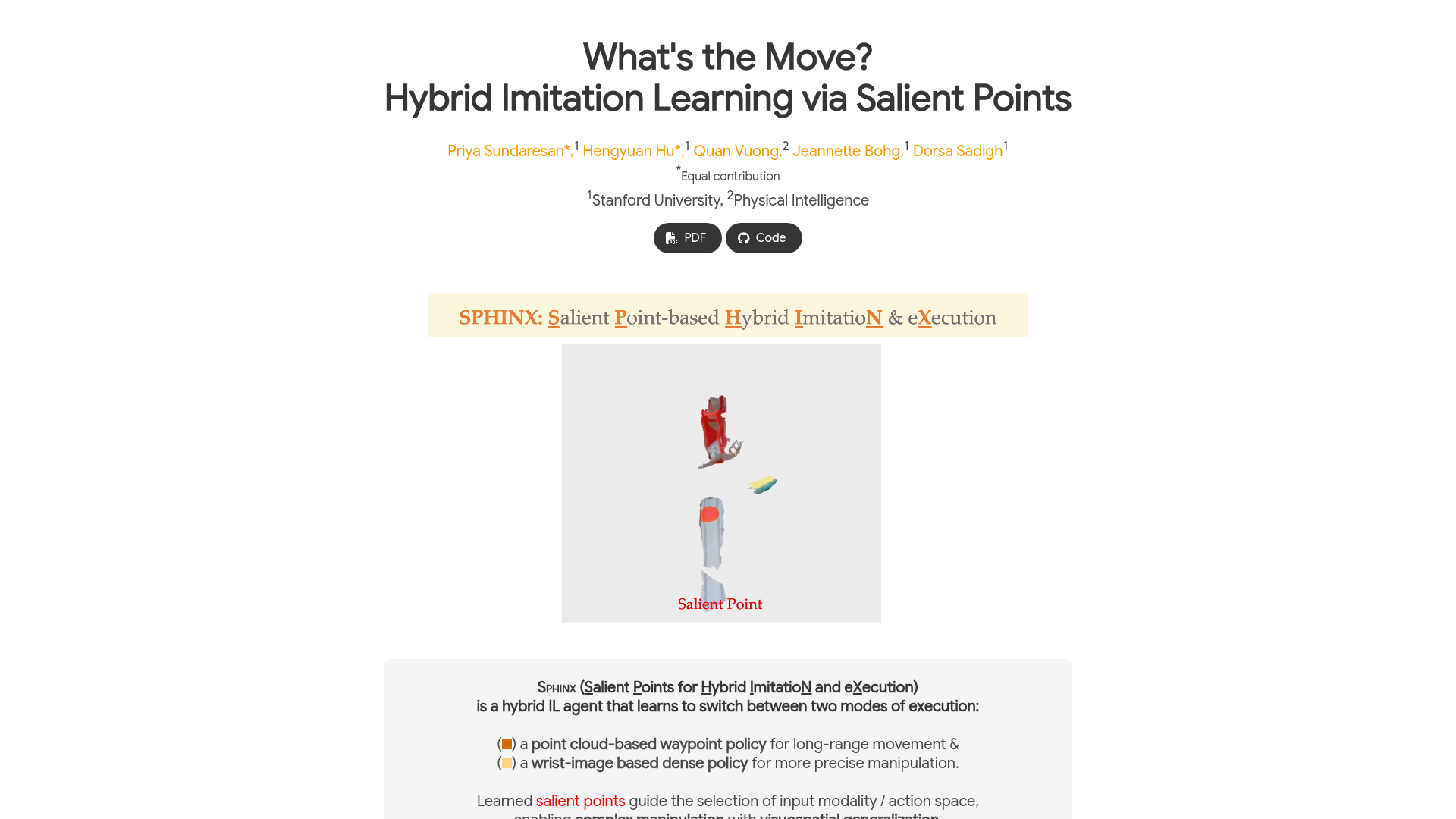
What it is
This website showcases Sphinx (Salient Points for Hybrid Imitation and Execution), a research project from Stanford University. It is a novel hybrid imitation learning (IL) agent designed to teach robots complex, long-horizon manipulation tasks. Sphinx learns to intelligently switch between two distinct execution modes: a point cloud-based waypoint policy for long-range movement and a wrist-image based dense policy for precise, close-up manipulation.
The method's core innovation is its use of learned salient points within a 3D point cloud. These semantically meaningful anchor points, like a mug handle or a coffee pod, guide the robot's spatial reasoning and dictate when to switch between its two action modes. This allows for robust generalization across various challenging conditions.
Sphinx is notable for its sample efficiency, achieving high performance after being trained on only 20 to 60 demonstrations. It effectively generalizes to unseen spatial arrangements, visual distractors, novel camera viewpoints, and different execution speeds, tackling tasks like coffee making and cup stacking.
The site serves as a portal for researchers and practitioners in robotics and artificial intelligence to learn about this state-of-the-art approach. It provides access to the academic paper, code, and video demonstrations of the agent successfully performing a variety of complex manipulation tasks in both real-world and simulated environments.
This description was generated by AI from the site's public content and may contain errors.
What you can do there
- Read the research paper
- Access the project code
- Watch video demonstrations
- Learn about the methodology
Who it's for
Researchers and practitioners in robotics, AI, and machine learning
Frequently asked questions about sphinx-manip.github.io
›What is hybrid imitation learning?
Hybrid imitation learning is a robotics approach that combines different policies and action spaces, such as sparse waypoints for long-range movement and dense actions for precise manipulation, within a single agent.
›What are salient points in robotics?
Salient points are task-relevant, semantically meaningful locations within a 3D point cloud, like the handle of a mug, that a robot learns to identify to guide its actions and improve spatial generalization.
›How does Sphinx switch between modes?
Sphinx uses a learned policy to predict when to switch from a point cloud-based waypoint mode for long-range movement to a wrist-camera image-based dense mode for precise manipulation near a salient point.
›What tasks can Sphinx perform?
As demonstrated, Sphinx can perform complex long-horizon tasks such as making coffee, stacking cups, assembling a train track, and opening drawers with high precision.
›How much training data does Sphinx require?
The Sphinx method is sample-efficient, designed to learn effectively from a limited set of 20 to 60 human demonstrations for a given task.
›How does Sphinx compare to other imitation learning methods?
According to the research, Sphinx significantly outperforms other state-of-the-art baselines, achieving higher success rates and better generalization to visual and spatial variations.
›Is the code for Sphinx available?
Yes, the website provides a link to access the code for the Sphinx project, allowing others to explore and build upon the research.