
Scanpy
Documentation for Scanpy, a Python toolkit for analyzing single-cell RNA sequencing data.
 ReadtheDocs
What it is
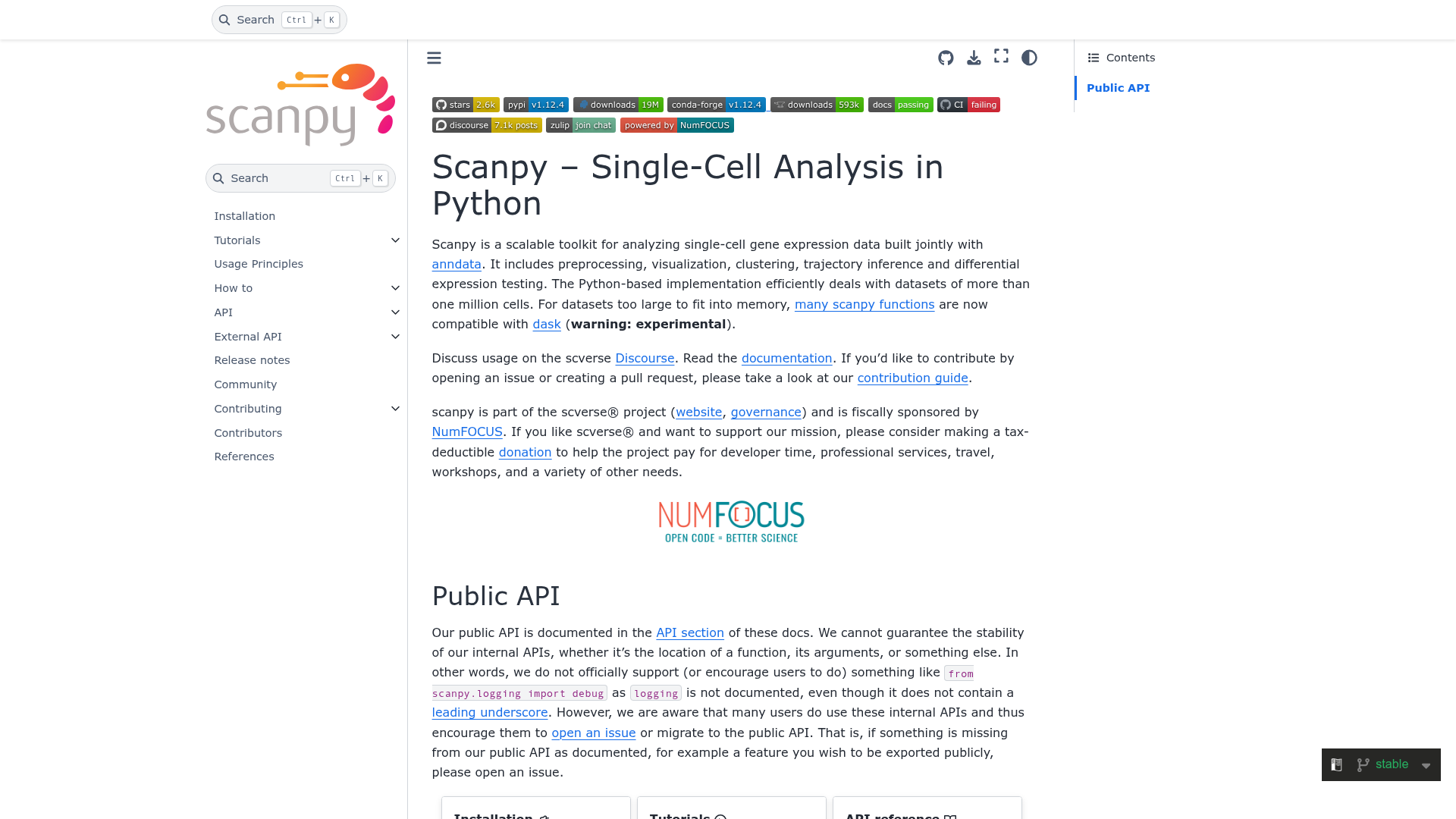
Scanpy is a comprehensive Python library for the analysis of single-cell gene expression data. It provides a full suite of tools for preprocessing, clustering, visualization, and trajectory inference, enabling researchers to explore and understand complex biological datasets. The toolkit is built to handle standard data formats and integrates seamlessly with the broader Python data science ecosystem.
The main features include extensive preprocessing functions for quality control and normalization, tools for neighborhood graph analysis and clustering, and a wide array of plotting functions for visualizing results. It supports advanced analyses such as differential expression testing, trajectory inference for processes like cell differentiation, and integration of multiple datasets.
Scanpy is designed for bioinformaticians, computational biologists, and researchers working with single-cell genomics. It helps users process raw count data, identify cell populations, discover marker genes, and create publication-quality figures. The workflow typically involves reading data, applying quality filters, normalizing, performing dimensionality reduction, clustering, and then exploring the results visually.
It is a key tool in the single-cell analysis field, notable for its scalability, extensive documentation, and active development community. The library is widely used in academia and industry for mining insights from high-throughput genomic data.
This description was generated by AI from the site's public content and may contain errors.
What you can do there
- Read single-cell data from various formats
- Preprocess and normalize raw count data
- Perform clustering and differential expression analysis
- Create visualizations like scatter plots and heatmaps
- Conduct trajectory inference analysis
Who it's for
Bioinformaticians, computational biologists, and researchers analyzing single-cell genomics data.
Frequently asked questions about scanpy.readthedocs.io
›What is Scanpy used for?
Scanpy is used for analyzing single-cell RNA sequencing data, including preprocessing, clustering, and visualizing cellular heterogeneity.
›How do I read 10x Genomics data into Scanpy?
You can use the scanpy.read_10x_mtx or scanpy.read_10x_h5 functions to load data from 10x Genomics standard output directories.
›How do I perform clustering on my data?
After preprocessing and PCA, use scanpy.pp.neighbors to compute a neighborhood graph and then scanpy.tl.leiden or scanpy.tl.louvain for clustering.
›How can I visualize clusters?
Use plotting functions like scanpy.pl.umap or scanpy.pl.tsne to visualize cell clusters and other annotations on a low-dimensional embedding.
›Does Scanpy support trajectory analysis?
Yes, Scanpy includes tools for trajectory inference, such as scanpy.tl.dpt, to model processes like cell differentiation.
›Can I use Scanpy with other Python libraries?
Yes, Scanpy is built on Anndata objects and integrates well with popular data science libraries like NumPy, SciPy, and scikit-learn.