
North Sea Scope
Comprehensive analysis of North Sea maritime resource rights, fishing quotas, and seabed mineral extraction across seven nations.
 Base44
What it is
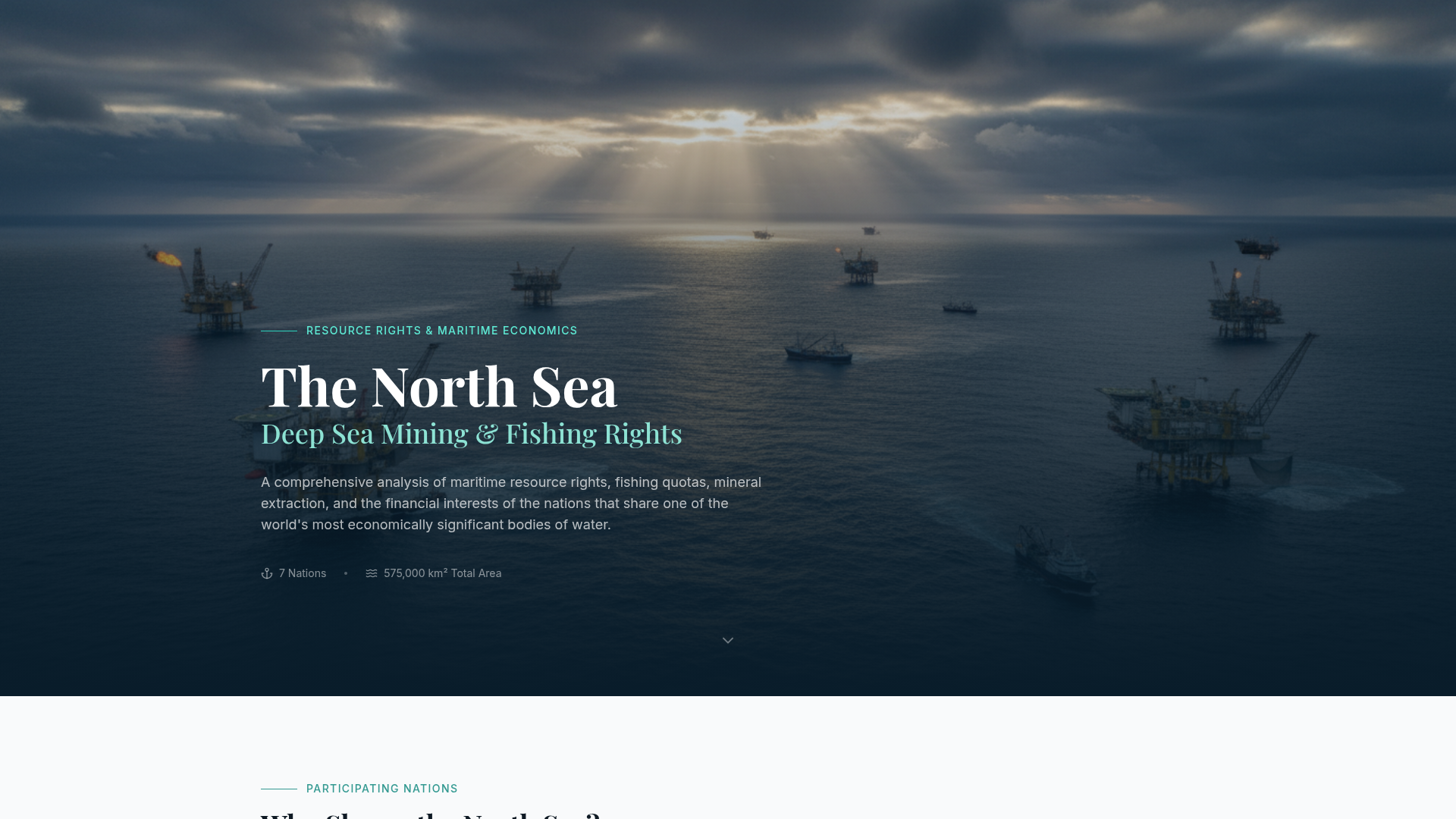
North Sea Scope provides a detailed examination of resource rights and maritime economics across one of the world's most economically significant bodies of water. The site breaks down Exclusive Economic Zone allocations for Norway, the United Kingdom, Denmark, the Netherlands, Germany, Belgium, and France, showing each nation's share of the 575,000 square kilometer area and their primary resource interests.
Visitors can explore annual fishing revenue data by nation, with quota allocations set through trilateral agreements between the EU, Norway, and the UK. The platform tracks key species including herring, cod, and haddock, displaying recent quota reductions and total catch volumes. Seabed resource analysis covers oil and gas production shares, sand and gravel extraction, and emerging deep-sea mineral deposits such as manganese nodules and rare earth elements.
Financial analysis sections present export and import trade balances for each nation, identifying net exporters like Norway and the UK alongside net importers such as Germany and France. The legal framework section outlines governing treaties including UNCLOS, the OSPAR Convention, EU Common Fisheries Policy, and International Seabed Authority regulations, with special attention to post-Brexit fishing rights negotiations.
The site serves researchers, policy analysts, maritime industry professionals, and students seeking authoritative data on North Sea resource governance. Its structured presentation of complex multi-national agreements and quantitative resource data makes it a valuable reference for understanding regional maritime economics.
This description was generated by AI from the site's public content and may contain errors.
What you can do there
- Compare EEZ allocations and resource rights across seven North Sea nations
- Analyze annual fishing quotas and revenue data by country and species
- Explore seabed mineral extraction breakdowns including emerging deep-sea mining
- Review import-export trade balances for petroleum, fish, and mineral resources
- Study the legal frameworks governing maritime resource management
Who it's for
Researchers, policymakers, maritime industry professionals, and students studying North Sea resource economics
Frequently asked questions about north-sea-scope.base44.app
›Which nations share the North Sea and what are their EEZ sizes?
Seven nations border the North Sea: Norway with 145,000 km², United Kingdom with 131,000 km², Denmark with 105,000 km², Netherlands with 58,500 km², Germany with 33,000 km², France with 5,200 km², and Belgium with 3,454 km².
›How are North Sea fishing quotas determined after Brexit?
Post-Brexit fishing quotas are negotiated through annual trilateral talks between the EU, Norway, and the UK. The 2026 agreement reduced herring quotas by 20% and cod quotas by 44% compared to 2025 levels.
›What seabed resources are extracted in the North Sea?
Extraction activities include oil and gas at 40%, sand and gravel at 35%, manganese nodules at 12%, rare earth minerals at 8%, and phosphorite at 5% of total seabed extraction.
›Which countries are net exporters of North Sea resources?
Norway, the United Kingdom, and Denmark are net exporters. Norway leads with a €65.6 billion trade surplus, followed by the UK at €7.5 billion and Denmark at €2.1 billion.
›What legal frameworks govern North Sea resource extraction?
Key frameworks include UNCLOS for EEZ establishment, OSPAR Convention for environmental protection, EU Common Fisheries Policy for quota management, and ISA regulations influencing deep-sea mining standards.
›What is Norway's position on deep-sea mining?
Norway approved deep-sea mining in January 2024, opening 281,000 km² of Arctic and North Sea seabed for mineral exploration targeting manganese, cobalt, copper, zinc, and rare earth elements.
›How much is the total annual value of North Sea fisheries?
The estimated annual value of North Sea fisheries exceeds €7.5 billion with total landings of 3.2 million tonnes from EU, Norway, and UK fleets combined.