
Machine Learning 101
A comprehensive open-source documentation website providing foundational tutorials and guides on core machine learning concepts and algorithms.
 ReadtheDocs
What it is
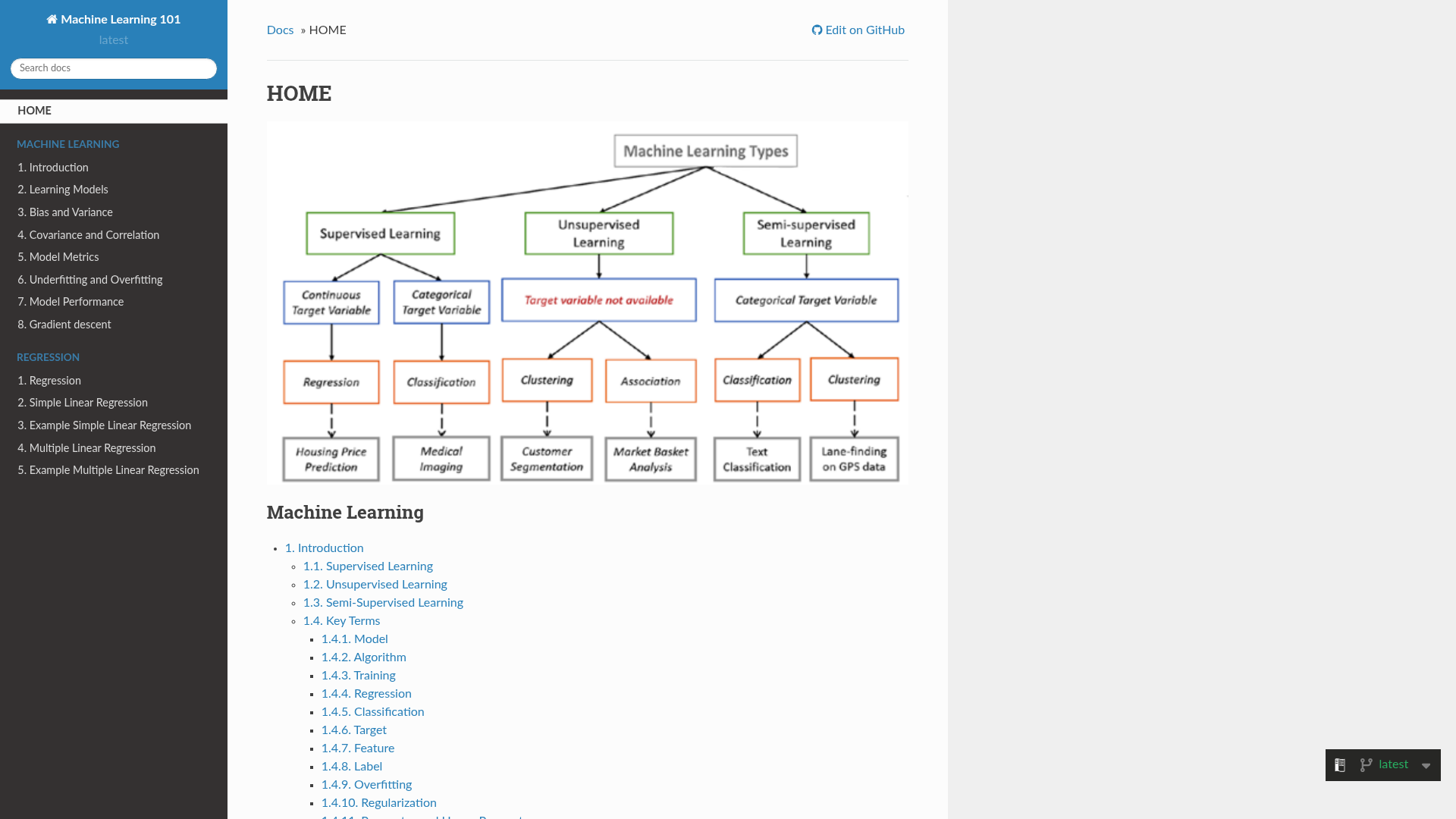
Machine Learning 101 is an extensive educational resource designed as a public documentation site. It serves as a complete guide for students, developers, and data scientists looking to build or solidify their understanding of fundamental machine learning principles. The site is structured into logical chapters, starting with a broad introduction to different learning types like supervised, unsupervised, and semi-supervised learning.
The documentation delves deep into key terminology, covering essential concepts such as models, algorithms, training, regression, classification, features, labels, and overfitting. It provides detailed explanations on critical topics like the bias-variance tradeoff, model metrics including MAE, MSE, and log loss, and practical guidance on handling underfitting and overfitting.
A significant portion of the content is dedicated to regression techniques, offering clear explanations and Python code examples for both simple and multiple linear regression using popular libraries like Scikit-learn. The guide also thoroughly explains optimization methods, with a dedicated section on gradient descent, its different types, and its role in model training.
This resource is notable for its practical approach, combining theoretical explanations with implementation examples, making it a valuable free learning tool for anyone entering the field of machine learning and artificial intelligence.
This description was generated by AI from the site's public content and may contain errors.
What you can do there
- Learn core machine learning concepts and terminology
- Study different types of learning models and algorithms
- Understand model evaluation metrics and performance
- Follow Python code examples for linear regression
- Read about optimization techniques like gradient descent
Who it's for
Students, developers, and data scientists learning the fundamentals of machine learning.
Frequently asked questions about machinelearning101.readthedocs.io
›What is the difference between supervised and unsupervised learning?
Supervised learning uses labeled data to train models for prediction or classification, while unsupervised learning finds hidden patterns or intrinsic structures in unlabeled data.
›What is the bias-variance tradeoff?
It is a fundamental concept in machine learning where simpler models may have high bias (underfitting) and complex models may have high variance (overfitting); the goal is to find a balance that minimizes total error.
›How do you evaluate a regression model?
Common metrics for evaluating regression models include Mean Absolute Error (MAE), Mean Squared Error (MSE), and R-squared, which measure the difference between predicted and actual values.
›What is gradient descent and how does it work?
Gradient descent is an optimization algorithm used to minimize a model's cost function by iteratively moving towards the steepest descent, defined by the negative of the gradient, to find the best parameters.
›What is the difference between covariance and correlation?
Covariance measures the direction of the linear relationship between two variables, while correlation measures both the strength and direction of that relationship.
›What are some common algorithms for classification?
The site covers algorithms within broader categories like Bayesian algorithms, decision trees, and ensemble methods, which are commonly used for classification tasks.