
KerrGeoPy
Python library for computing bound timelike geodesics in Kerr spacetime for EMRI research
 ReadtheDocs
What it is
KerrGeoPy is a specialized Python library designed for computing bound timelike geodesics in Kerr spacetime, the mathematical description of rotating black holes in general relativity. The library serves researchers working on extreme-mass-ratio inspirals (EMRIs), which are key gravitational wave sources for future space-based detectors like LISA. It implements analytical solutions for both stable bound orbits and plunging orbits based on established physics literature from Dyson, van de Meent, Fujita, and Hikida.
The software provides a comprehensive set of modules for orbital mechanics calculations in strong gravitational fields. Core classes include StableOrbit for bound trajectories, PlungingOrbit for infalling trajectories, Orbit for initial condition specifications, and KerrSpacetime for spacetime geometry. Additional modules handle constants of motion, orbital frequencies, initial condition conversions, and unit transformations between geometrized and physical units.
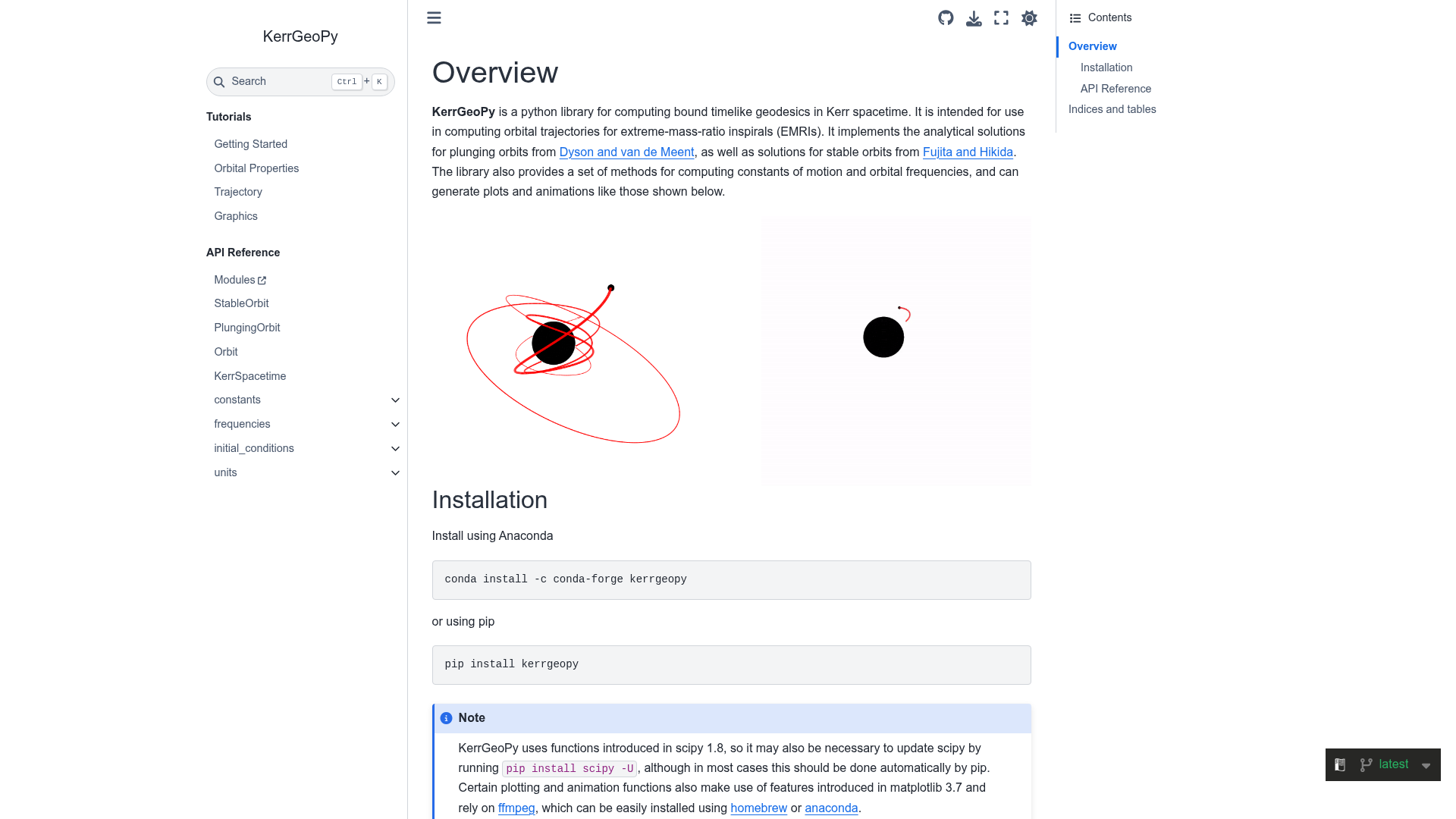
Installation is straightforward through conda-forge or pip, with dependencies on SciPy 1.8+ and optional matplotlib 3.7+ for visualization features. The library generates publication-quality plots and animations of orbital trajectories, making it valuable for both computational analysis and scientific communication. Documentation includes tutorials covering getting started, orbital properties, trajectory graphics, and alternative parametrizations.
Researchers in gravitational wave astronomy, theoretical astrophysics, and general relativity will find this tool essential for modeling EMRI waveforms and testing strong-field gravity. The analytical approach provides computational efficiency compared to numerical integration, enabling large parameter space explorations required for data analysis pipelines. The codebase is open source and maintained by Seyong Park with versioned documentation hosted on Read the Docs.
As a focused scientific computing tool, KerrGeoPy fills a specific niche in the gravitational wave community by providing validated, ready-to-use implementations of complex analytical solutions that would otherwise require significant development effort from individual research groups.
This description was generated by AI from the site's public content and may contain errors.
What you can do there
- Compute stable and plunging orbits in Kerr spacetime
- Calculate constants of motion and orbital frequencies
- Convert between initial conditions and orbital parameters
- Generate trajectory plots and animations
- Transform between geometrized and physical units
Who it's for
Gravitational wave researchers, theoretical astrophysicists, general relativity scientists
Frequently asked questions about kerrgeopy.readthedocs.io
›What is KerrGeoPy used for?
KerrGeoPy computes bound timelike geodesics in Kerr spacetime for extreme-mass-ratio inspiral research and gravitational wave modeling.
›How do I install KerrGeoPy?
Install via conda with 'conda install -c conda-forge kerrgeopy' or pip with 'pip install kerrgeopy'. SciPy 1.8+ is required.
›What orbit types does KerrGeoPy support?
The library supports stable bound orbits, plunging orbits, and orbits defined by initial conditions in Kerr spacetime.
›Can KerrGeoPy generate visualizations?
Yes, it includes plotting and animation functions for orbital trajectories using matplotlib and ffmpeg.
›What physics solutions are implemented?
Analytical solutions for plunging orbits from Dyson and van de Meent, and stable orbits from Fujita and Hikida.
›Does KerrGeoPy handle unit conversions?
Yes, the units module converts between geometrized units and physical units like SI, CGS, and astronomical units.
›Who maintains KerrGeoPy?
The library is developed and maintained by Seyong Park with documentation hosted on Read the Docs.