
HAIC
Research framework for humanoid robot interaction with underactuated objects using dynamics-aware world models
 GitHub
What it is
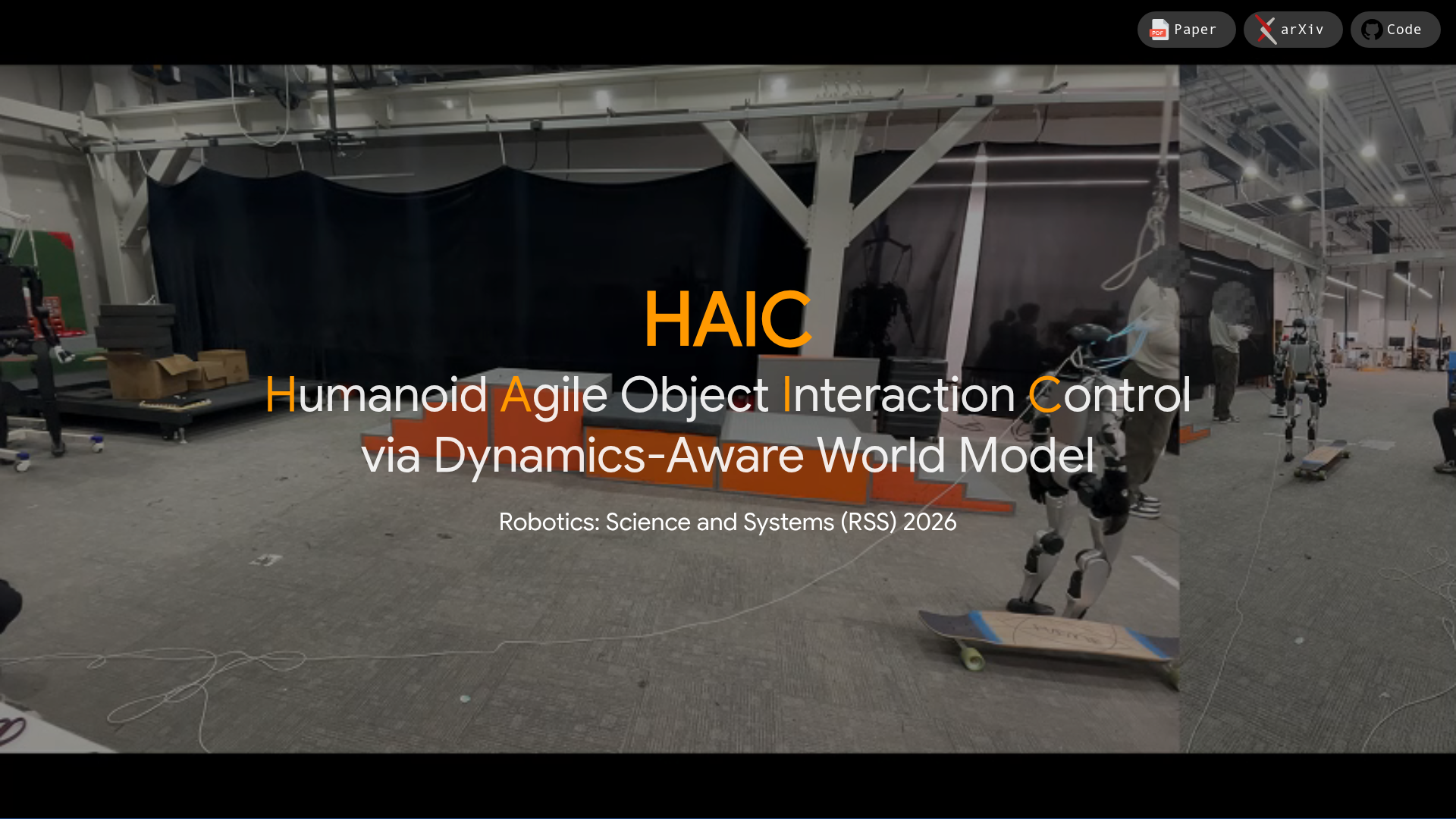
HAIC is a robotics research project that introduces a unified framework for humanoid agile object interaction control through a dynamics-aware world model. The system enables robots to manipulate underactuated objects such as skateboards, carts, and wheeled platforms that possess independent dynamics and non-holonomic constraints. Unlike traditional approaches that focus on fully actuated objects rigidly coupled to robot end-effectors, HAIC addresses the pervasive challenge of objects with complex coupling forces and frequent visual occlusions.
This description was generated by AI from the site's public content and may contain errors.
What you can do there
- View research paper and abstract
- Access arXiv preprint
- Browse source code repository
- Watch demonstration videos of robot interactions
- Read BibTeX citation entry
Who it's for
Robotics researchers, machine learning engineers, humanoid robotics community, academic labs
Frequently asked questions about haic-humanoid.github.io
›What is the HAIC framework designed for?
HAIC enables humanoid robots to interact with underactuated objects like skateboards and carts by predicting high-order object dynamics from proprioceptive history.
›Which robot platform was used for evaluation?
The framework was evaluated on a Unitree G1 humanoid robot across multiple interaction tasks.
›What types of object interactions does HAIC support?
HAIC supports skateboarding, cart pushing, cart pulling, sequential multi-object tasks, and multi-terrain traversal with carried objects.
›How does the dynamics predictor work?
The predictor infers object velocity and acceleration solely from proprioceptive history and projects predictions onto static geometric priors for spatially grounded dynamic occupancy representation.
›Is the code and paper publicly available?
Yes, the project provides links to the RSS 2026 paper, arXiv preprint, and source code repositories.
›What generalization capabilities does HAIC demonstrate?
The system generalizes across varying box sizes and weights, terrain rotation angles from 0 to 45 degrees, and load weights up to 70 kg for pushing and 20 kg for pulling tasks.
›Who are the researchers behind HAIC?
The project involves researchers from Tsinghua University, HKUST Guangzhou, ETH Zurich, and Xiaomi Robotics Lab with equal contributions from multiple authors.