
Embodied Data Atlas
Embodied Data Atlas is a public directory for embodied intelligence datasets, helping researchers find, compare, and verify data sources for AI and robotics.
 ChatGPT Sites
What it is
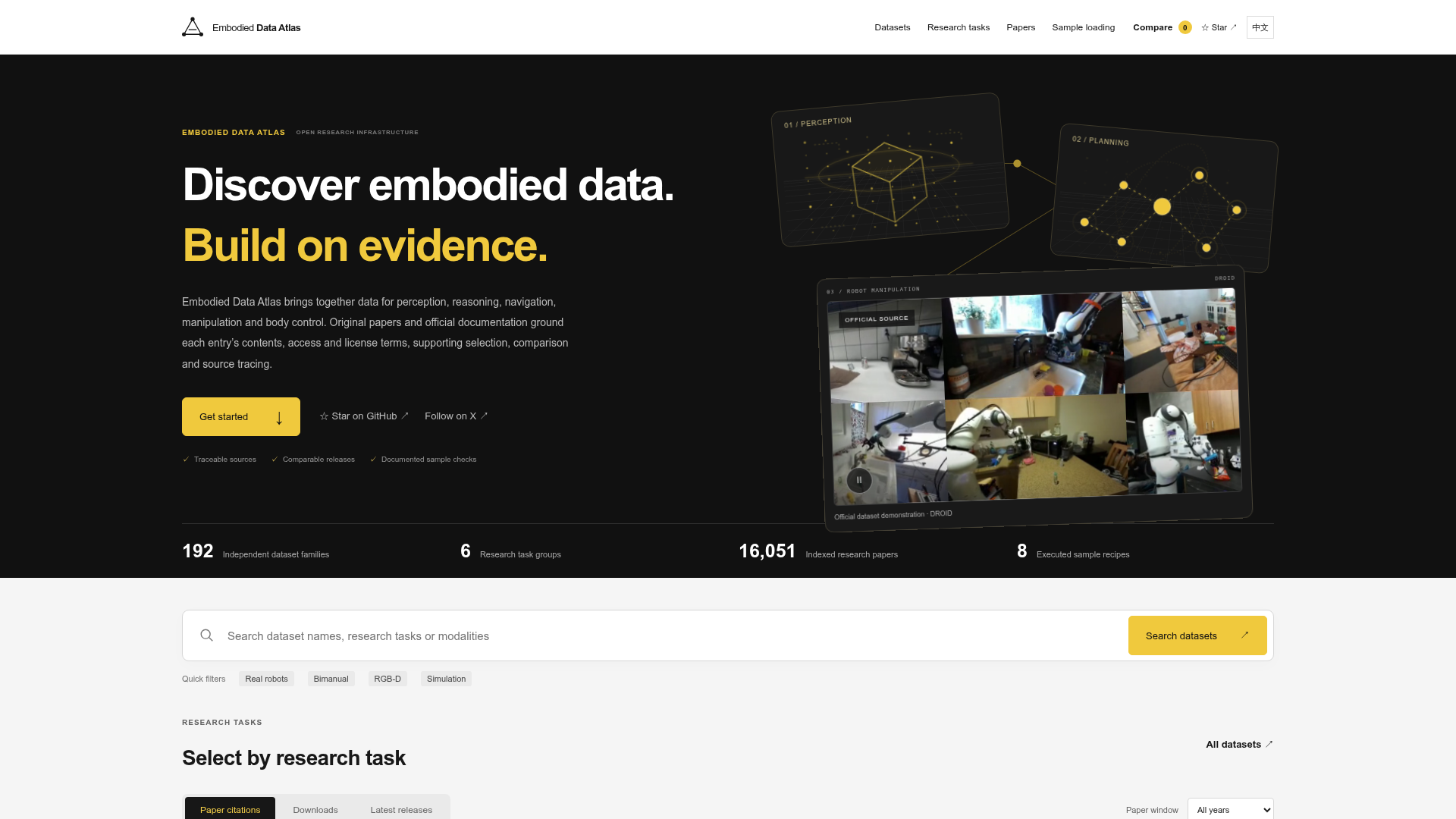
Embodied Data Atlas is an open research infrastructure dedicated to aggregating and curating datasets for embodied intelligence. It covers key areas such as perception, reasoning and planning, navigation, manipulation, motion control, and comprehensive embodied tasks. The platform organizes data based on original research papers and official documentation, providing details on content, access methods, and licensing conditions to support academic research and reproducibility.
The site features a comprehensive dataset catalog with over 170 dataset families classified into six research tasks. Users can browse datasets filtered by citations, recent popularity, publication year, and environment (real-world or simulation). Each dataset profile includes specifications like observation types, acquisition conditions, annotations, and official demonstrations, enabling informed decision-making.
It primarily serves researchers, students, and developers in artificial intelligence, robotics, and machine learning who require reliable data for training models, benchmarking, and replicating studies. The directory helps users quickly identify suitable datasets, trace their origins, and understand usage evidence from linked research papers.
To get started, visitors can search datasets by name or explore categories like perception or manipulation. The comparison tool allows side-by-side evaluation of multiple datasets, and the research paper retrieval function provides insights into real-world applications. The project is community-supported, with updates maintained through GitHub and feedback channels.
What makes Embodied Data Atlas notable is its focus on traceability to official sources, version comparability, and recorded sample verifications. It emphasizes open access and transparency, making it a valuable resource for advancing embodied AI research without commercial barriers.
This description was generated by AI from the site's public content and may contain errors.
What you can do there
- Browse dataset catalog by research tasks
- Search and filter datasets based on citations and conditions
- Compare datasets using a side-by-side checklist
- Retrieve research papers with dataset usage evidence
- View detailed dataset profiles with official demonstrations
Who it's for
Researchers and developers in artificial intelligence, robotics, and machine learning fields
Frequently asked questions about embodied-data-atlas.aqua-goat-8174.chatgpt.site
›What is Embodied Data Atlas?
It is a curated directory of datasets for embodied intelligence, providing details on data sources, access conditions, and research applications to aid AI and robotics researchers.
›How can I find datasets for my research?
You can search datasets by name or browse through categories like perception, navigation, or manipulation, with filters for citation count, environment, and publication year.
›Are the datasets free to use?
Access conditions vary; some datasets are publicly available for download, while others require accepting user agreements or licenses, as specified in each profile.
›Can I compare different datasets?
Yes, the site offers a comparison feature where you can add datasets to a checklist to evaluate their specifications, sources, and conditions side by side.
›Is there information on how datasets are used in research?
Yes, you can retrieve research papers that cite the datasets and view verified usage cases to understand practical applications and outcomes.
›How often is the directory updated?
The catalog is regularly maintained, with dataset families undergoing source collection and updates, as noted in the catalog metadata and GitHub repository.
›How can I contribute or report issues?
You can provide feedback via email or follow the project on Xiaohongshu for updates; community contributions are encouraged through the GitHub platform.