
CoRA Docs
Documentation for CoRA, a web application for inventorying and analyzing commingled human remains in forensic and archaeological contexts.
 ReadtheDocs
What it is
CoRA Docs provides comprehensive documentation for the Commingled Remains Analytics (CoRA) web application, database, and APIs. This platform is a community resource designed for forensic anthropologists, archaeologists, and researchers working with assemblages of commingled human remains. It offers a structured framework for inventorying remains, complete with analytic methods, visualization techniques, and tools to assist in the segregation and identification process.
The system features multiple modules for handling different data types, including Specimens, DNA, Dental, Isotopes, and Individuals. It includes robust site navigation, user roles, permissions, and detailed reporting capabilities through Org reports, User reports, and Project reports. The platform also provides various dashboards for project management, DNA analysis, individual tracking, isotope studies, and missing persons cases.
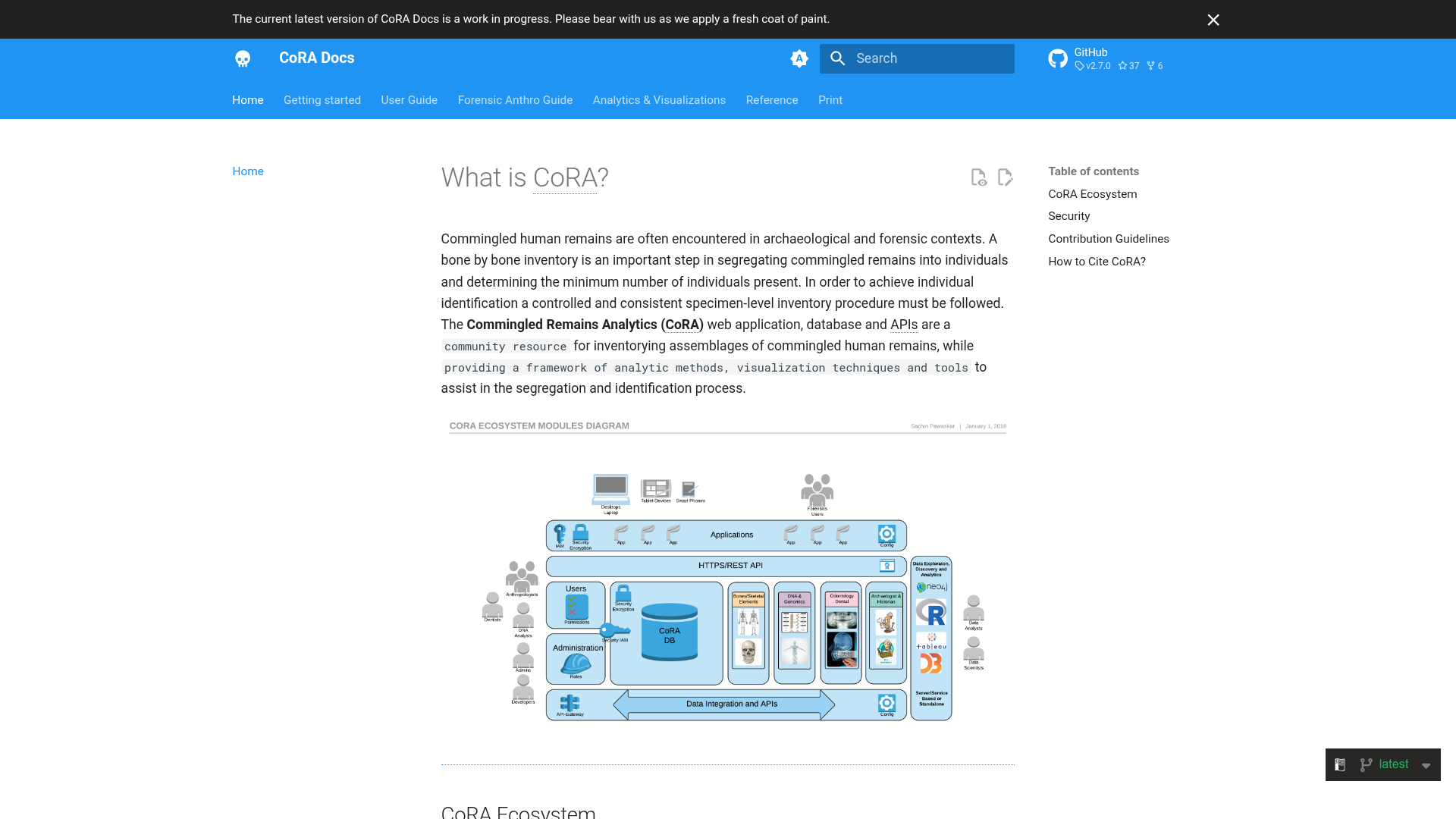
CoRA is built on a flexible, extensible, and modular architecture, allowing for the integration of new applications and advanced analytics modules. It emphasizes security, aiming to meet requirements outlined in DoDI 8582.01 and NIST SP 800-171-r2, with future plans for Cybersecurity Maturity Model Certification (CMMC) compliance.
The documentation covers user guides, forensic anthropology references, analytics visualizations like bipartite graphs and hierarchical clustering, and knowledge graphs. It is an open community resource, with contribution guidelines available for those wishing to submit documentation or report issues.
This description was generated by AI from the site's public content and may contain errors.
What you can do there
- Read documentation for the CoRA web application
- Learn about forensic anthropology guidelines and methods
- Explore analytics and visualization tools for commingled remains
- Review security protocols and contribution guidelines
- Access reference materials for country, language, and timezone data
Who it's for
Forensic anthropologists, archaeologists, researchers, and professionals working with commingled human remains.
Frequently asked questions about cora-docs.readthedocs.io
›What is CoRA used for?
CoRA is used for inventorying and analyzing commingled human remains in forensic and archaeological contexts to assist in segregation and identification.
›Is CoRA secure?
Yes, CoRA is built with security in mind and aims to comply with DoDI 8582.01, NIST SP 800-171-r2, and future CMMC standards.
›How can I contribute to CoRA documentation?
Documentation for the current stable release should be submitted to the corresponding branch on GitHub, while documentation for the next release goes to the master branch.
›What modules does CoRA include?
CoRA includes modules for Specimens, DNA, Dental, Isotopes, Individuals, Reports, Dashboards, and Drilldowns for detailed data analysis.
›How do I cite CoRA in research?
CoRA should be cited as Pawaskar et al., 2021, with the full citation available in the documentation.
›Does CoRA support mobile devices?
Yes, CoRA includes mobile readiness features for accessing the platform on various devices.
›What analytics visualizations are available in CoRA?
CoRA offers built-in analytics like bipartite graphs, collapsible trees, hierarchical clustering, scatterplots, and knowledge graphs for data visualization.