
Clld
Documentation for the CLLD Python framework for building linguistic databases
 ReadtheDocs
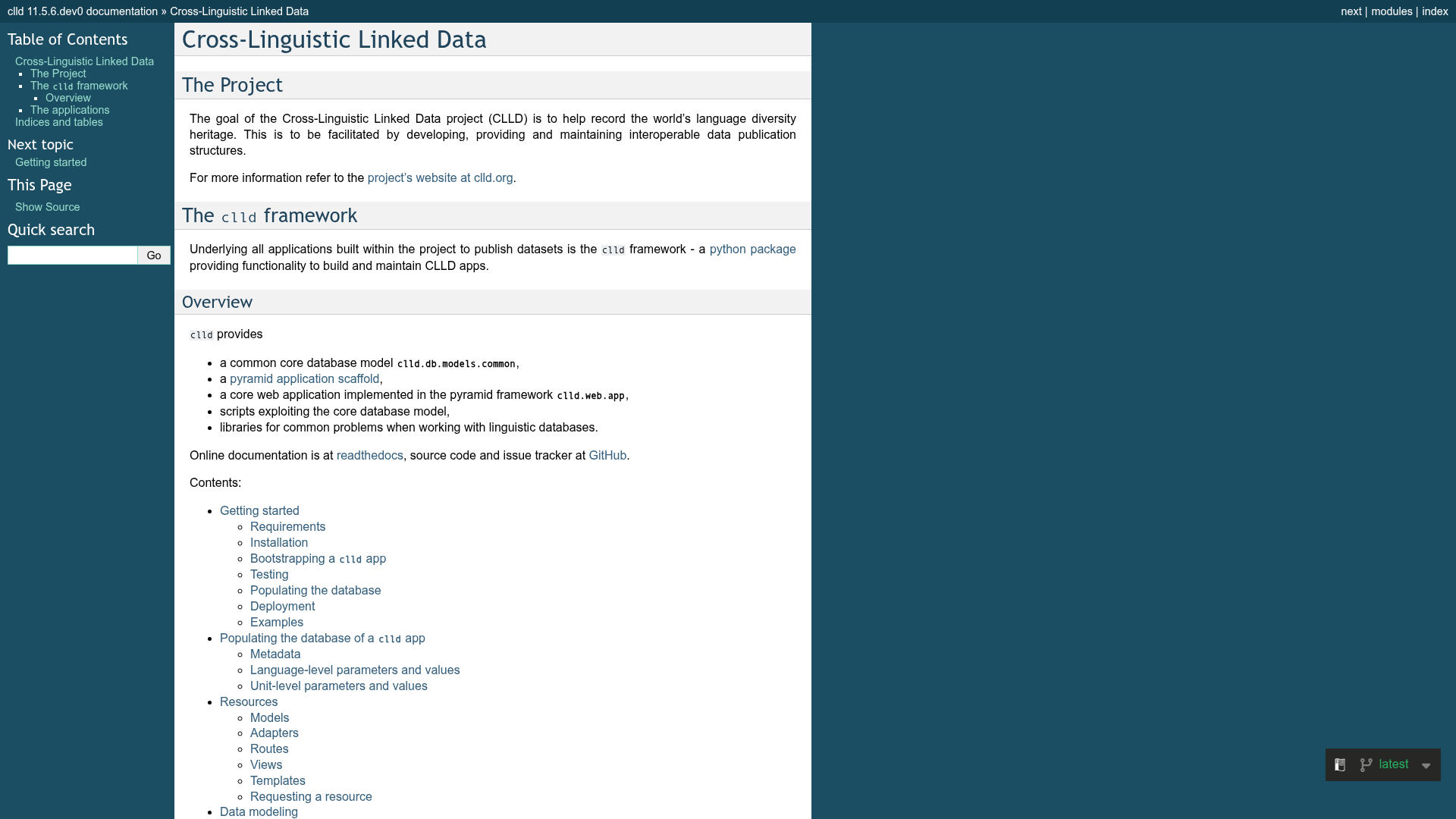
What it is
The CLLD documentation site provides comprehensive guides for the Cross-Linguistic Linked Data framework, a Python package designed to help researchers record and publish the world's language diversity. The framework supplies a common core database model, a Pyramid application scaffold, and a core web application that together enable the creation of interoperable linguistic databases.
Key features include scripts for database population, libraries for common linguistic data problems, and built-in support for linked data vocabularies such as RDF, BibTeX, and COinS. The system also offers advanced components like custom maps, datatables, OAI-PMH for OLAC, and sitemap generation, allowing developers to tailor applications to specific dataset requirements.
The primary audience consists of linguists, digital humanities researchers, and software developers who need to publish structured language data online. By providing a standardized scaffold, CLLD reduces the effort required to launch a new linguistic database while ensuring compliance with linked data principles.
Getting started is straightforward: the documentation covers requirements, installation, bootstrapping a new CLLD app, testing, and deployment. Detailed sections on data modeling, custom URLs, static assets, and menu items guide developers through extending the base framework for their own datasets.
Notable aspects include the project's backing by the Max Planck Society, its open-source availability on GitHub, and a growing list of real-world CLLD datasets that demonstrate the framework's versatility. The documentation itself is generated with Sphinx and hosted on ReadTheDocs, ensuring it remains accessible and versioned alongside the code.
This description was generated by AI from the site's public content and may contain errors.
What you can do there
- Read full framework documentation
- Download and install the CLLD Python package
- Browse source code on GitHub
- Explore example linguistic datasets
- Learn data modeling and customization techniques
Who it's for
Linguists, researchers, and developers building language databases
Frequently asked questions about clld.readthedocs.io
›What is the CLLD framework?
CLLD is a Python framework that provides a database model, Pyramid web application scaffold, and tools for building and maintaining web applications that publish linguistic datasets as linked data.
›How do I install CLLD?
Installation instructions are in the getting started section; typically you install the package via pip, then use the provided scaffold to generate a new project structure.
›Which web framework does CLLD use?
CLLD is built on the Pyramid web framework and uses SQLAlchemy for database modeling.
›Can I customize the generated web application?
Yes, the documentation details customization of wording, static pages, templates, static assets, menu items, datatables, maps, and custom URLs.
›Where can I see example applications built with CLLD?
The documentation points to a list of CLLD datasets that serve as real-world examples of applications developed on the framework.
›Is CLLD open source?
Yes, the source code and issue tracker are hosted on GitHub under the Max Planck Society.
›What data formats and protocols does CLLD support?
CLLD supports RDF, BibTeX, COinS, OAI-PMH for OLAC, sitemaps, and custom linked data vocabularies.