
ClimateLearn
ClimateLearn is a Python library providing standardized access to climate data and machine learning models for weather forecasting and climate science research.
 ReadtheDocs
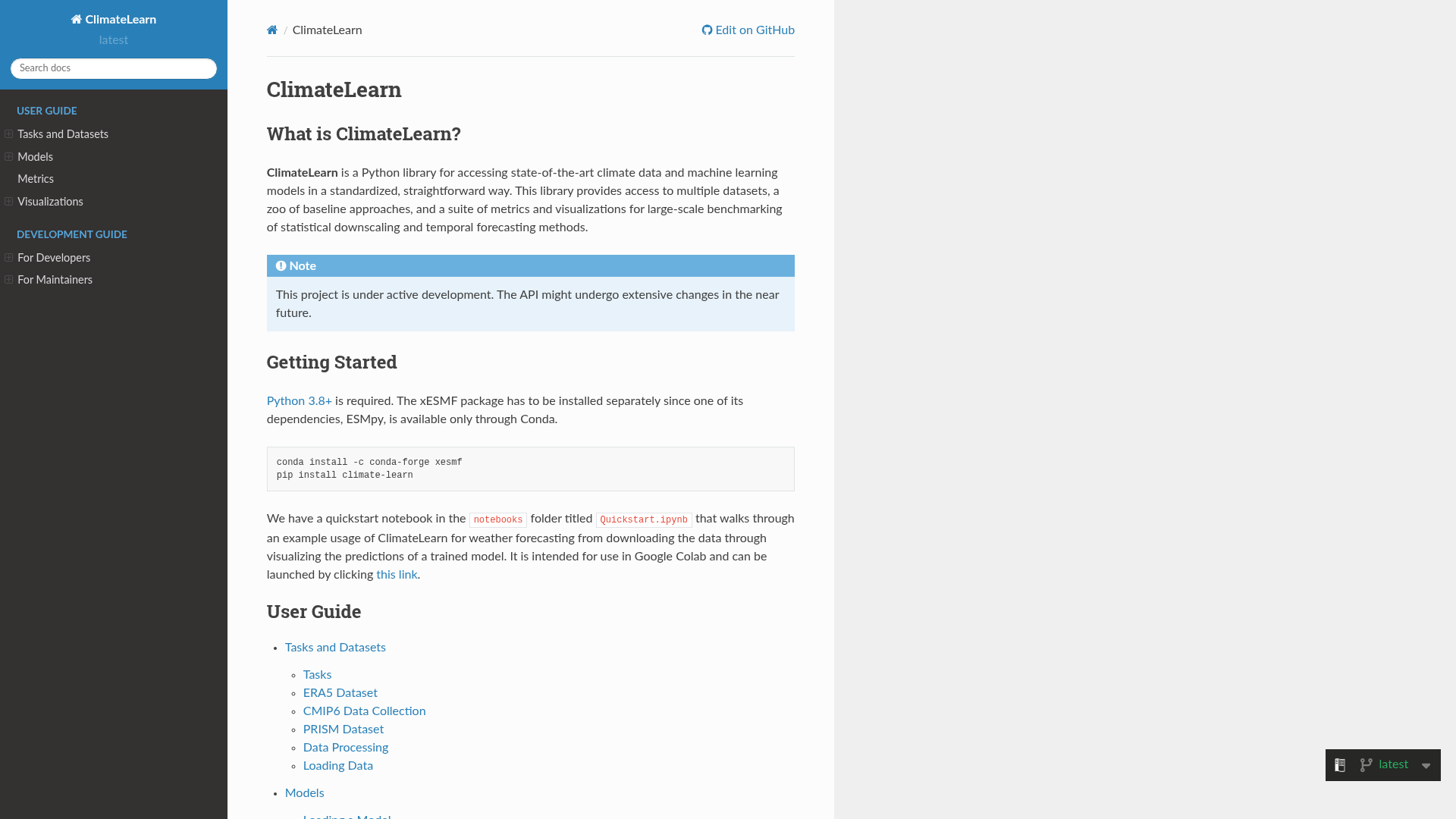
What it is
ClimateLearn is a comprehensive Python library designed for researchers and data scientists working in climate science and machine learning. It offers standardized access to multiple climate datasets including ERA5, CMIP6, and PRISM, along with a zoo of baseline machine learning models for weather forecasting and statistical downscaling tasks.
The library provides tools for data processing, model loading, and evaluation metrics, enabling large-scale benchmarking of climate models. Users can visualize specific predictions and average performance through built-in visualization tools, facilitating rigorous and reproducible data-driven climate science.
ClimateLearn is particularly valuable for academic researchers, climate scientists, and ML practitioners who need access to curated climate datasets and standardized evaluation protocols. The project supports tasks such as temporal forecasting and statistical downscaling, making it easier to compare different approaches and reproduce results.
Getting started requires Python 3.8+ and includes installation via pip, though the xESMF package must be installed separately through Conda. The project provides a quickstart notebook available on Google Colab that walks users through downloading data, training models, and visualizing predictions.
Built and maintained by the Machine Intelligence Group at UCLA, ClimateLearn addresses the need for a holistic software ecosystem in climate science that encompasses data, modeling, and evaluation across multiple tasks, filling gaps left by existing leaderboard benchmarks like WeatherBench and ClimateBench.
This description was generated by AI from the site's public content and may contain errors.
What you can do there
- Access multiple climate datasets including ERA5 and CMIP6
- Use pre-implemented machine learning models for climate tasks
- Evaluate models with standardized metrics and visualizations
- Process and load climate data in standardized formats
- Reproduce benchmarks for statistical downscaling and forecasting
Who it's for
Climate scientists, researchers, and machine learning practitioners working on weather and climate modeling
Frequently asked questions about climatelearn.readthedocs.io
›What datasets does ClimateLearn provide access to?
ClimateLearn provides access to multiple climate datasets including ERA5, CMIP6, and PRISM data collections for weather and climate research.
›What machine learning tasks does ClimateLearn support?
The library supports tasks such as temporal forecasting and statistical downscaling methods for climate science applications.
›How do I install ClimateLearn?
ClimateLearn requires Python 3.8+ and can be installed via pip, though the xESMF dependency must be installed separately through Conda.
›Does ClimateLearn provide model evaluation tools?
Yes, ClimateLearn includes a suite of metrics and visualization tools for evaluating model performance and comparing predictions.
›Is there a quick start guide available?
Yes, ClimateLearn provides a Quickstart notebook on Google Colab that demonstrates downloading data, training models, and visualizing results.
›Who maintains the ClimateLearn project?
ClimateLearn is built and maintained by the Machine Intelligence Group at UCLA under Professor Aditya Grover.
›Can I use ClimateLearn for weather forecasting research?
Yes, ClimateLearn is specifically designed for weather forecasting and climate modeling research using machine learning approaches.