
Bnelearn
An open-source Python framework for simulating sealed-bid auctions and learning Bayesian Nash equilibria using AI.
 ReadtheDocs
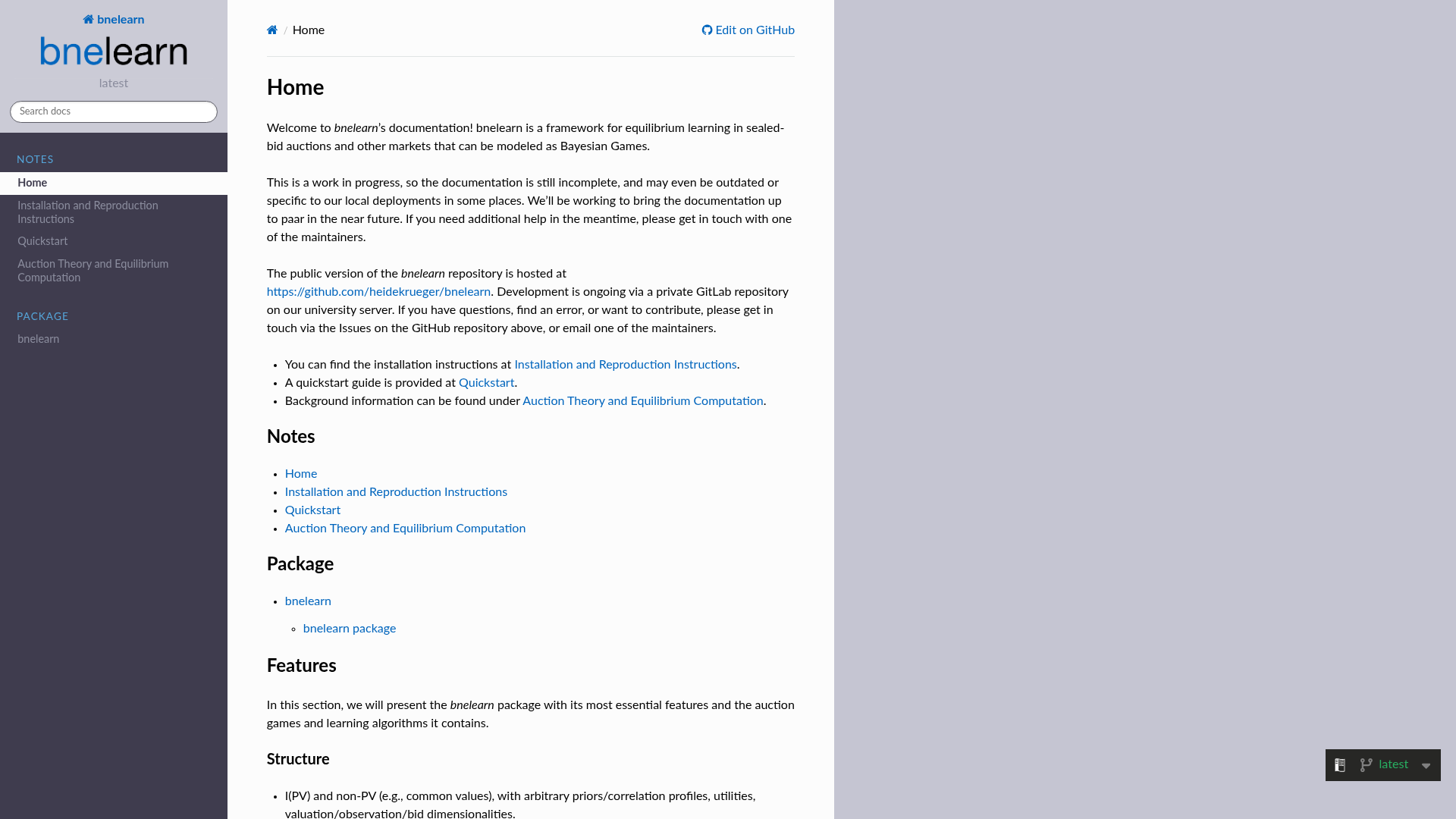
What it is
bnelearn is a specialized Python framework designed for researchers and developers working on equilibrium learning in sealed-bid auctions and other Bayesian games. It provides a modular environment for simulating various auction types, including single-item, multi-unit, and complex combinatorial auctions like LLG and LLLLGG. The framework supports a wide range of utility functions, priors, and correlation profiles, allowing for highly customizable market simulations.
The toolkit is built for performance, offering full vectorization and CUDA support for massive parallelism. This enables users to run large batches of auction simulations efficiently. It includes built-in metrics for analyzing learning progress, market efficiency, revenue, and individual payoffs, along with plotting capabilities for visualizing results.
bnelearn is particularly valuable for economists, game theorists, and AI researchers interested in mechanism design and multi-agent learning. It helps users study how bidders might behave in different auction formats and learn strategic equilibria through simulation.
The framework includes several predefined learning algorithms, such as Policy Gradient learners, Neural Pseudogradient Ascent (NPGA), and Particle Swarm Optimization (PSO). These are implemented to work with the auction environments provided. For combinatorial auctions, it even integrates a custom batched CUDA-enabled QP solver and supports Gurobi/Cvxpy for mixed-integer programs.
As an open-source project maintained by an academic institution, bnelearn is freely available. Its documentation, while a work in progress, provides installation instructions, a quickstart guide, and theoretical background to help new users get started with auction theory and equilibrium computation.
This description was generated by AI from the site's public content and may contain errors.
What you can do there
- Simulate various auction games like single-item and combinatorial auctions
- Learn Bayesian Nash equilibria using AI algorithms like PG, NPGA, and PSO
- Analyze auction metrics including efficiency, revenue, and payoffs
- Run massively parallel simulations with CUDA support
- Utilize predefined correlation profiles and utility functions
Who it's for
Researchers and developers in economics, game theory, and multi-agent AI systems
Frequently asked questions about bnelearn.readthedocs.io
›What types of auctions can I simulate with bnelearn?
You can simulate single-item auctions, multi-unit auctions, and combinatorial auctions like the LLG and LLLLGG models. The framework supports various priors, utility functions, and bid languages.
›What learning algorithms are included?
bnelearn includes implementations of Policy Gradient methods, Neural Pseudogradient Ascent (NPGA), and Particle Swarm Optimization (PSO) for learning equilibria.
›Does bnelearn support GPU acceleration?
Yes, the framework is fully vectorized and CUDA enabled, allowing for massive parallelism to run large batches of auction simulations efficiently.
›Is bnelearn suitable for studying risk-averse bidders?
Yes, it supports quasi-linear utility for risk-neutral bidders, as well as risk-averse and risk-seeking utility functions.
›How does bnelearn compare to other multi-agent learning frameworks?
Unlike platforms focused on discrete action spaces or zero-sum games, bnelearn specializes in continuous action spaces for auctions and offers efficient batch evaluation for parallel simulation.
›Is technical support available for bnelearn?
As an open-source project, support is provided via the GitHub repository's issue tracker or by contacting the academic maintainers directly.
›Can I use bnelearn for commercial applications?
You should review the license terms on its GitHub repository, but as an academic framework, it is primarily designed for research and simulation purposes.