
Bmicro
Documentation for BMicro, a graphical interface for Brillouin microscopy data analysis.
 ReadtheDocs
What it is
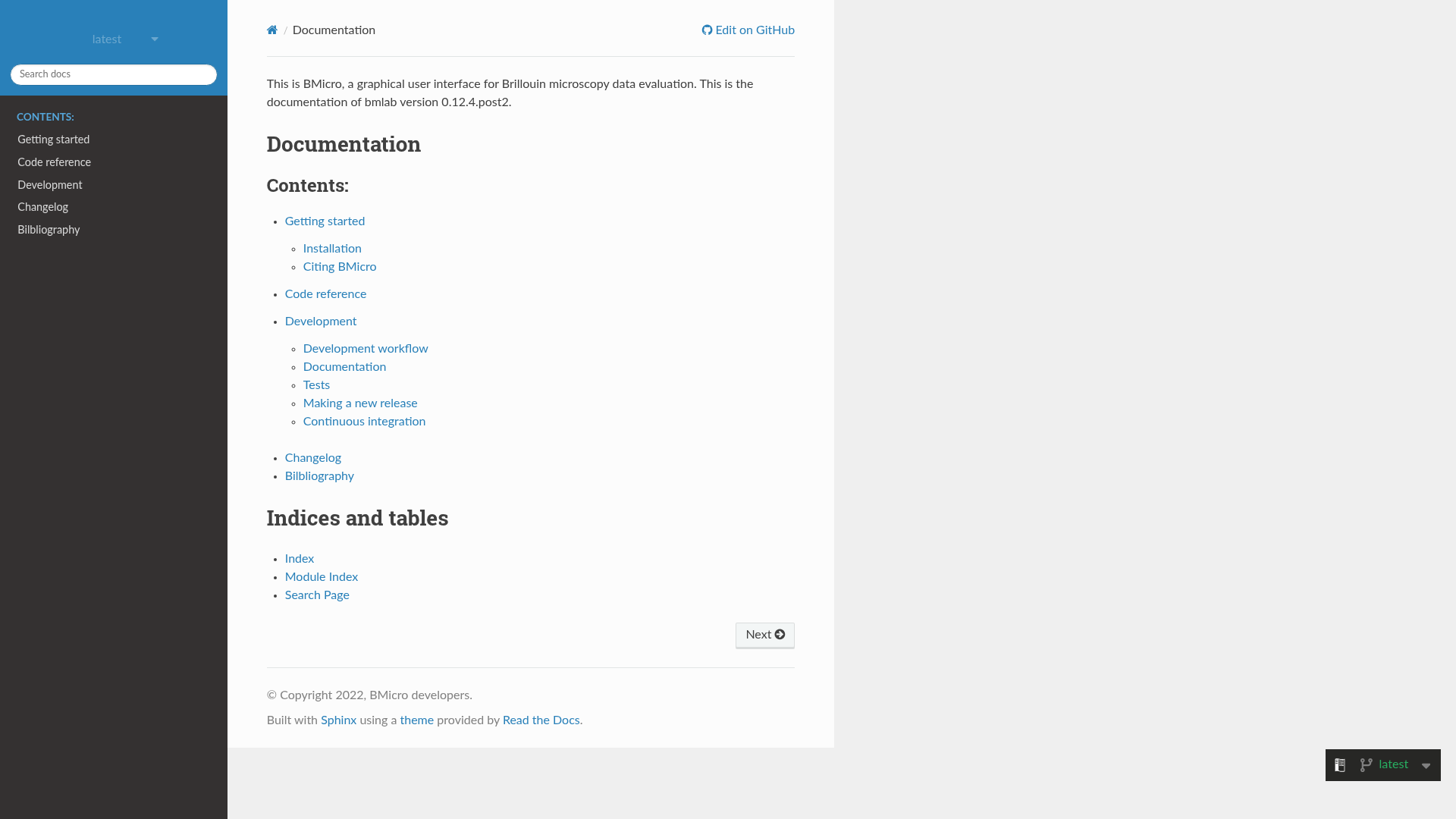
This site hosts the official documentation for BMicro, a graphical user interface designed for Brillouin microscopy data evaluation. The documentation is built with Sphinx and served via Read the Docs, offering versioned access to guides for every release from early 0.1 versions up to the latest stable 0.12.4.post2. Visitors can navigate through a structured table of contents that covers getting started, installation, code reference, development workflows, and a detailed changelog.
The documentation provides step‑by‑step installation instructions, a getting started tutorial, and a comprehensive code reference for developers who want to understand or extend the software. It also includes a development section that outlines the contribution workflow, testing procedures, release process, and continuous integration setup. A bibliography section helps users cite BMicro correctly in scientific publications, reinforcing its role in the research community.
The primary audience consists of researchers, optical scientists, and software developers who work with Brillouin microscopy data. By offering clear, version‑controlled documentation, the site lowers the barrier to adopting BMicro for data processing and encourages community contributions. The inclusion of a module index and search functionality makes it easy to locate specific classes, functions, or configuration options.
Getting started is straightforward: users select the desired version from the sidebar, follow the installation guide for their platform, and then proceed to the tutorial to learn basic operations. The development section caters to contributors by documenting coding standards, test execution, and the steps required to prepare a new release. This transparency supports an open‑source development model.
Notable aspects of the project include its long version history, active maintenance, and the use of standard Python packaging and documentation tools. The site exemplifies how scientific software projects can provide professional‑grade documentation that serves both end users and developers, fostering reproducibility and collaboration in microscopy research.
This description was generated by AI from the site's public content and may contain errors.
What you can do there
- Browse versioned documentation for BMicro
- Follow installation and getting started guides
- Explore code reference and API documentation
- Learn about development workflow and contribution guidelines
- Access changelog and release history
Who it's for
Researchers and developers working with Brillouin microscopy data analysis.
Frequently asked questions about bmicro.readthedocs.io
›What is BMicro?
BMicro is a graphical user interface for evaluating Brillouin microscopy data, providing tools for visualization and analysis of spectral measurements.
›How do I install BMicro?
The documentation includes an installation guide with platform‑specific instructions; typically you can install it via pip from the Python Package Index after ensuring required dependencies are met.
›Where can I find the API reference for BMicro?
The code reference section of the documentation provides a module index and detailed descriptions of classes, functions, and configuration options.
›How can I contribute to BMicro development?
The development workflow page outlines the contribution process, including coding standards, running tests, and submitting pull requests through the project GitHub repository.
›Which versions of BMicro are documented?
The site hosts documentation for all releases from 0.1.1 up to the latest stable 0.12.4, plus the main development branch and a smoke‑test branch.
›How do I cite BMicro in a research paper?
The bibliography section provides the recommended citation format and metadata for referencing BMicro in scientific publications.
›Is BMicro open source?
Yes, BMicro is developed as an open‑source project and its source code is available on GitHub under a permissive license.