
AtomNeb
A Python library providing access to atomic data for calculating nebular emission line fluxes in astrophysical research.
 ReadtheDocs
What it is
AtomNeb is a specialized Python package designed for astrophysicists and astronomers. It provides a comprehensive suite of tools for working with atomic data necessary for calculating emission line fluxes from ionized nebulae, such as planetary nebulae and H II regions.
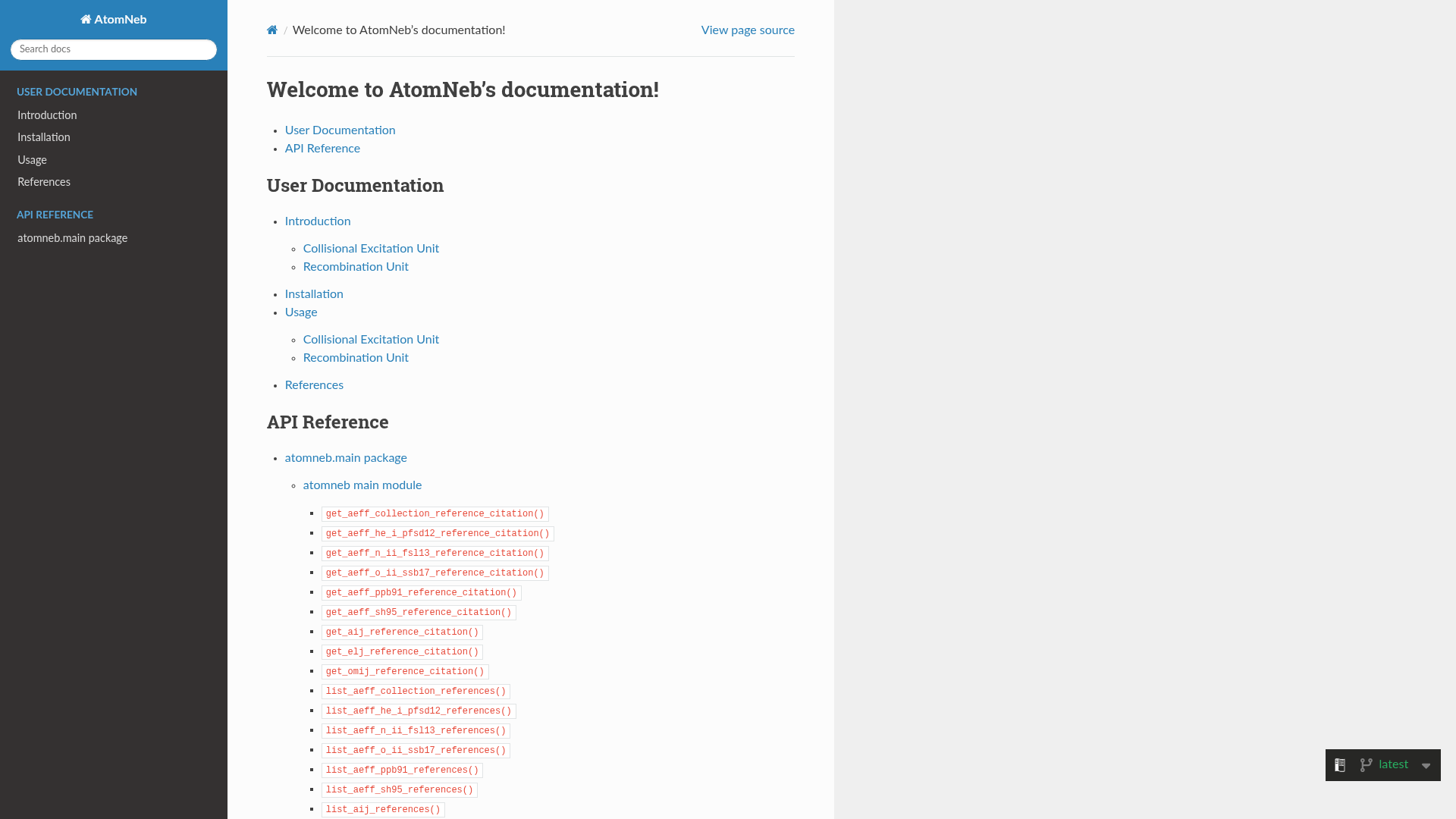
The library offers functions to read, search, and retrieve effective collision strengths (aeff), transition probabilities (Aij), and energy levels (Elj) for various ions. These datasets are sourced from peer-reviewed scientific literature, including works by prominent researchers in the field like PFSD12, FSL13, and SSB17.
Researchers and students use AtomNeb to model and analyze spectroscopic data from astronomical observations. It helps in determining physical conditions like electron temperatures and densities within nebulae, which are crucial for understanding stellar evolution and nucleosynthesis.
The package is built for integration into larger data analysis workflows, typically within a Python environment using common scientific libraries. Its API is structured to allow easy access to specific atomic datasets and their corresponding reference citations, ensuring proper attribution in scientific work.
This tool is notable for its focus on a specific and complex niche in astrophysics, providing a streamlined, programmatic alternative to manually consulting large atomic databases. It is an essential utility for professionals and academics working in nebular astrophysics.
This description was generated by AI from the site's public content and may contain errors.
What you can do there
- Read effective collision strength data for various ions
- Retrieve transition probabilities (Aij) and energy levels (Elj)
- Search specific atomic datasets
- Get reference citations for the sourced data
- List available data references for academic use
Who it's for
Astrophysicists, astronomers, and researchers modeling ionized nebulae
Frequently asked questions about atomneb-py.readthedocs.io
›What is AtomNeb used for?
AtomNeb is used to calculate emission line fluxes from ionized nebulae by providing access to atomic data like effective collision strengths and transition probabilities, which is essential for astrophysical research.
›Who is the target audience for AtomNeb?
Its primary users are astrophysicists, astronomers, and graduate students who are conducting research on planetary nebulae, H II regions, and other ionized astrophysical plasmas.
›How do I install the AtomNeb Python package?
You can install AtomNeb using standard Python package managers like pip, though the specific installation commands are detailed in its documentation.
›What atomic data does AtomNeb provide?
The library provides data for various ions, including effective collision strengths for He I, N II, and O II, as well as transition probabilities (Aij) and energy levels (Elj), sourced from cited scientific literature.
›Is AtomNeb free to use?
Yes, as an open source scientific library, AtomNeb is free to use for research and educational purposes.
›Can I cite the data sources used by AtomNeb?
Yes, the package includes functions like get_aeff_collection_reference_citation() to retrieve the proper reference citations for the atomic data you use, ensuring academic credit is given.