
Astronn
A Python library for applying neural networks to astronomical data analysis, featuring Bayesian models and tools for APOGEE, Gaia, and LAMOST datasets.
 ReadtheDocs
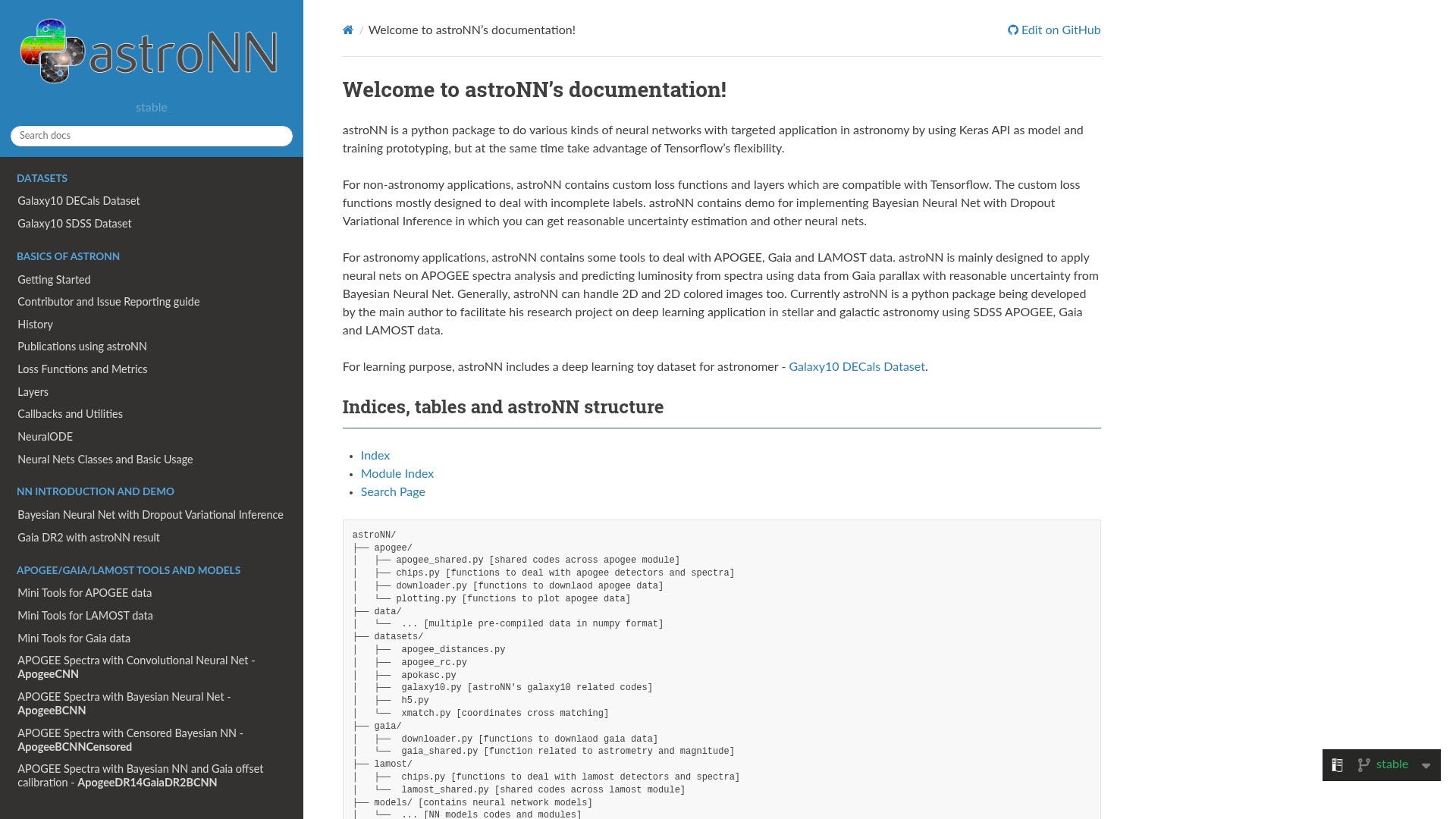
What it is
astroNN is a specialized Python package built on TensorFlow and Keras for developing neural network models with applications in astronomy. It provides custom loss functions and layers compatible with TensorFlow, particularly designed to handle incomplete labels common in scientific datasets.
The library includes implementations of Bayesian Neural Networks using Dropout Variational Inference, enabling researchers to obtain reasonable uncertainty estimates alongside predictions. It also features tools specifically tailored for working with astronomical survey data from APOGEE, Gaia, and LAMOST.
For astronomy applications, astroNN offers specialized capabilities for APOGEE spectra analysis and predicting stellar luminosities from spectra using Gaia parallax data. The package includes several pre-built neural network architectures including convolutional neural networks, variational autoencoders, and encoder-decoder models specifically designed for astronomical data.
Researchers and data scientists working in astronomy can benefit from astroNN's curated datasets like the Galaxy10 DECals Dataset, which serves as a deep learning toy dataset for astronomers. The package facilitates various neural network applications on astronomical spectra and images while providing uncertainty quantification through Bayesian methods.
The project includes comprehensive documentation, contributor guidelines, and maintains a history of versions and publications that have utilized the library, making it a valuable resource for the astronomical machine learning community.
This description was generated by AI from the site's public content and may contain errors.
What you can do there
- Bayesian Neural Network implementation with uncertainty estimation
- Tools for processing APOGEE, Gaia, and LAMOST astronomical data
- Custom loss functions for handling incomplete labels
- Galaxy10 DECals Dataset for deep learning practice
- Convolutional neural networks for spectral analysis
Who it's for
Astronomers, astrophysicists, and data scientists working with astronomical survey data and machine learning
Frequently asked questions about astronn.readthedocs.io
›What is astroNN used for?
astroNN is used for applying neural networks to astronomical data analysis, particularly for spectral data from surveys like APOGEE, Gaia, and LAMOST, with capabilities for uncertainty estimation through Bayesian methods.
›Does astroNN support Bayesian Neural Networks?
Yes, astroNN implements Bayesian Neural Networks with Dropout Variational Inference, providing predictive uncertainty estimation for regression and classification tasks on astronomical data.
›What astronomical surveys does astroNN support?
astroNN provides specialized tools and models for APOGEE, Gaia, and LAMOST survey data, including downloaders, processing utilities, and neural network architectures tailored for each survey's data format.
›Can I use astroNN for non-astronomy applications?
While designed for astronomy, astroNN's custom loss functions and layers are compatible with TensorFlow and can be adapted for other applications requiring handling of incomplete labels or uncertainty estimation.
›What neural network architectures are available in astroNN?
astroNN includes convolutional neural networks, variational autoencoders, Bayesian neural networks, encoder-decoder models, and specialized architectures like StarNet implementation for astronomical applications.
›Is there example data available to learn astroNN?
Yes, astroNN provides the Galaxy10 DECals Dataset as a deep learning toy dataset specifically curated for astronomers to learn and experiment with neural network techniques.
›How do I get started with astroNN?
The documentation provides getting started guides, prerequisites, and configuration instructions, including information on using astroNN on Google Colab for easy experimentation.