
ARTEMIS
An open-source, high-performance electrodynamics simulation code for microelectronics research, built on WarpX and AMReX.
 ReadtheDocs
What it is
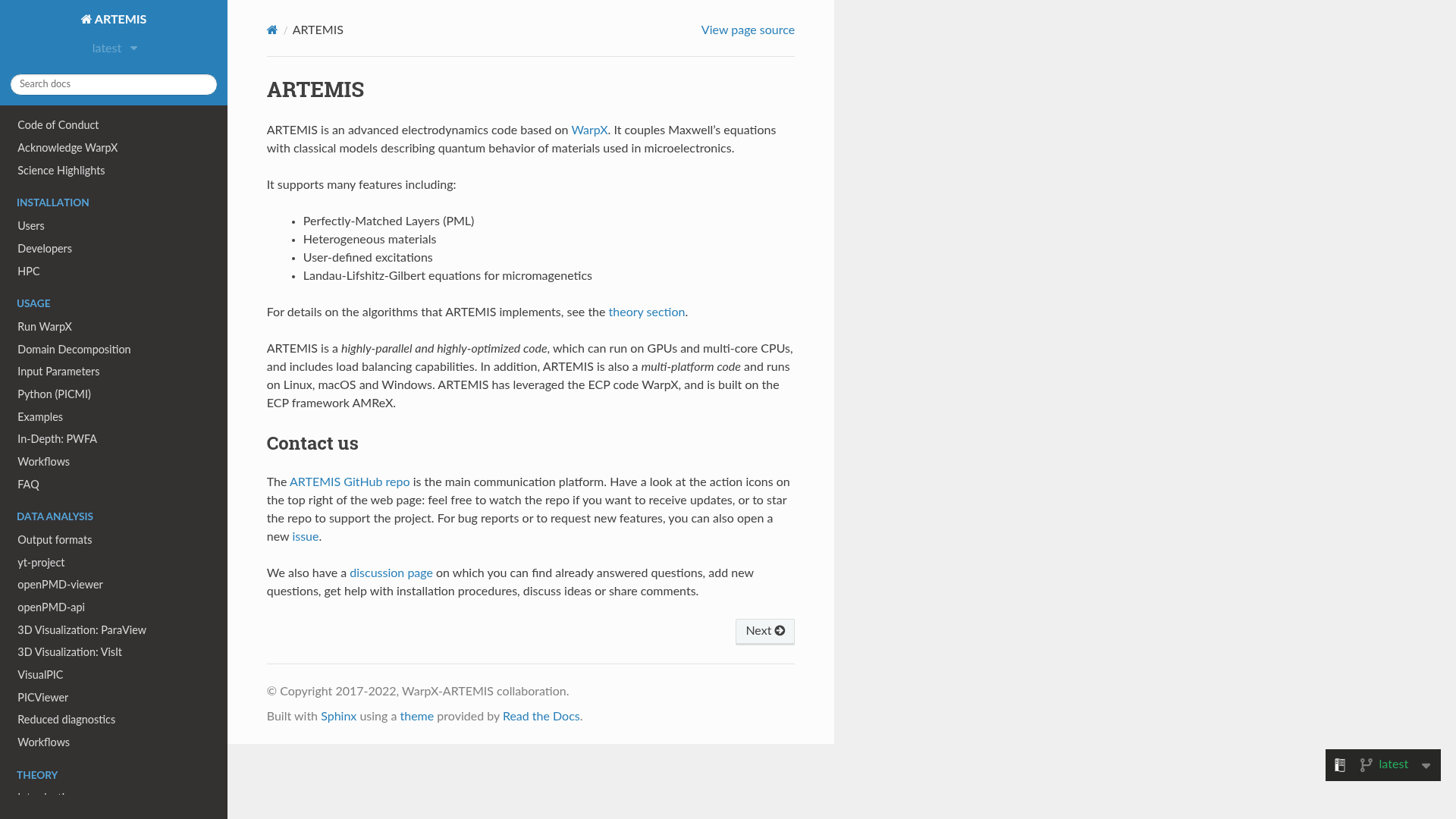
ARTEMIS is an advanced electrodynamics simulation code designed for modeling quantum behavior in microelectronic materials. It couples Maxwell's equations with classical models to provide high-fidelity simulations of complex electromagnetic phenomena. The code supports key features including Perfectly-Matched Layers (PML), heterogeneous materials, user-defined excitations, and Landau-Lifshitz-Gilbert equations for micromagnetics.
Built on the ECP framework AMReX and leveraging the WarpX codebase, ARTEMIS is optimized for high-performance computing environments. It runs efficiently on GPUs and multi-core CPUs across Linux, macOS, and Windows platforms. The code includes sophisticated capabilities like domain decomposition, load balancing, and parallel processing for large-scale scientific simulations.
Researchers and engineers working in computational physics and microelectronics development can use ARTEMIS for simulating electromagnetic interactions at quantum scales. The tool is particularly valuable for academic institutions, national laboratories, and semiconductor companies engaged in materials research and device development.
The project provides comprehensive documentation covering installation procedures, input parameters, Python interfaces through PICMI, and various data analysis methods. Users can output data in multiple formats including openPMD and utilize visualization tools like ParaView, VisIt, and yt-project for result interpretation.
Notable aspects include its open-source nature, strong scientific foundation, and integration with established high-performance computing frameworks. The code represents a specialized tool in computational electrodynamics with applications in semiconductor research, materials science, and quantum device modeling.
This description was generated by AI from the site's public content and may contain errors.
What you can do there
- Access electrodynamics simulation code
- Review technical documentation
- Explore Python interface examples
- Learn simulation theory and methods
- Participate in community discussions
Who it's for
Researchers, engineers, and students in computational physics and microelectronics development
Frequently asked questions about artemis-em.readthedocs.io
›What is ARTEMIS used for?
ARTEMIS is used for simulating electrodynamics and quantum behavior in microelectronic materials, helping researchers model electromagnetic phenomena at microscopic scales.
›Does ARTEMIS support GPU acceleration?
Yes, ARTEMIS is highly optimized for GPU computing and can run on both GPUs and multi-core CPUs for efficient large-scale simulations.
›What operating systems does ARTEMIS support?
ARTEMIS runs on Linux, macOS, and Windows operating systems, making it accessible across different computing environments.
›How can I analyze simulation data from ARTEMIS?
ARTEMIS supports multiple output formats including openPMD, and can be analyzed with tools like yt-project, ParaView, VisIt, and openPMD-viewer.
›Is ARTEMIS open source?
Yes, ARTEMIS is an open-source project hosted on GitHub where users can access the code, report issues, and contribute to development.
›What simulation methods does ARTEMIS implement?
ARTEMIS implements particle-in-cell methods, filtering, mesh refinement, boundary conditions, and moving window techniques for advanced electrodynamics simulations.
›How do I get started with ARTEMIS?
The documentation provides installation guides, input parameter documentation, and Python examples using PICMI to help users begin simulations.