
Analytics Zoo
Documentation for Analytics Zoo, an open-source platform scaling TensorFlow and PyTorch on Apache Spark and Ray for big data AI workloads.
 ReadtheDocs
What it is
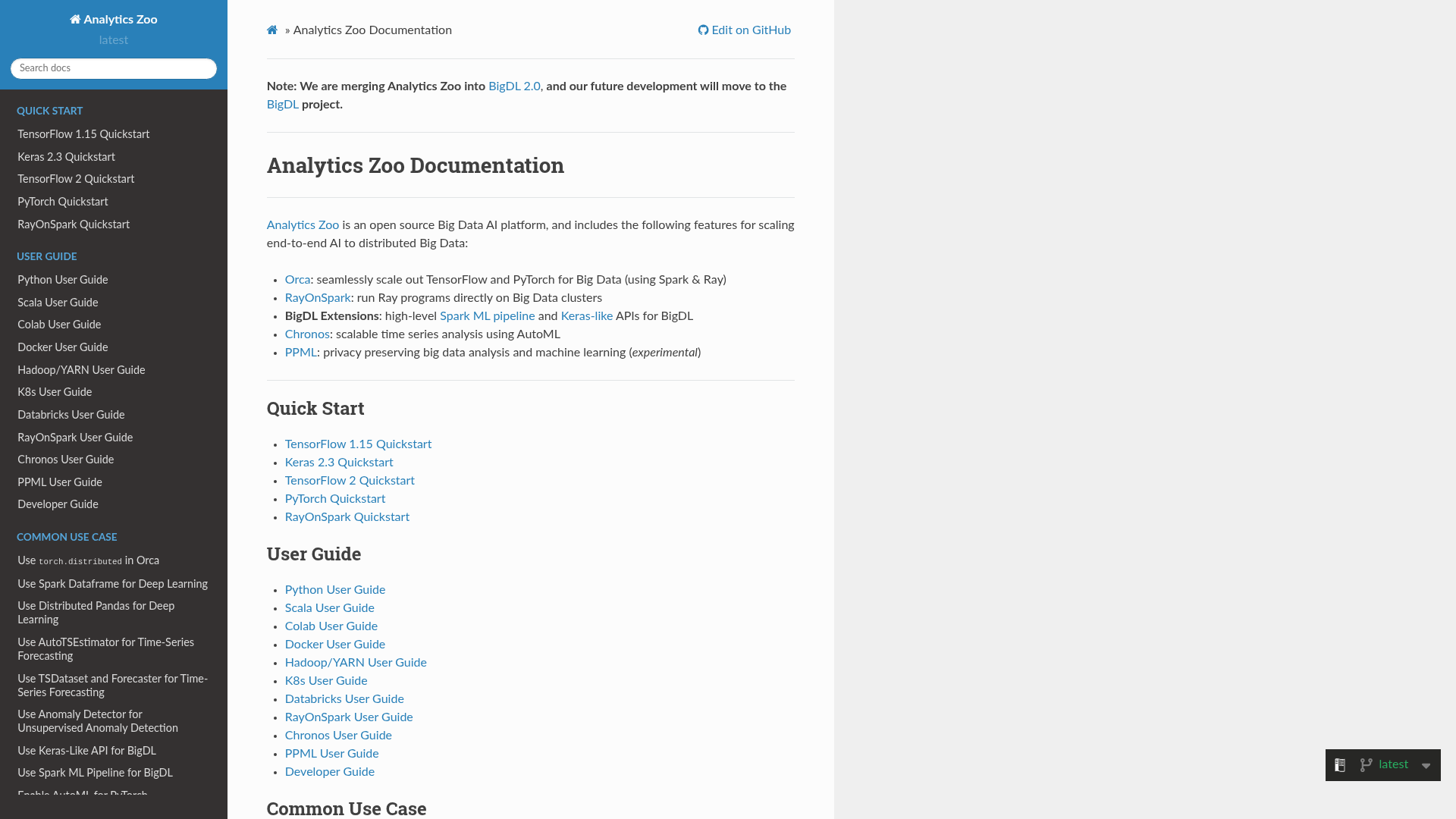
Analytics Zoo is an open-source Big Data AI platform that enables developers and data scientists to scale end-to-end artificial intelligence applications across distributed clusters. The platform integrates seamlessly with Apache Spark and Ray to provide unified analytics and AI pipelines for large-scale data processing and model training.
Key components include Orca for scaling TensorFlow and PyTorch programs with minimal code changes, RayOnSpark for running Ray applications directly on big data clusters, and BigDL extensions offering high-level Spark ML pipelines and Keras-like APIs. Chronos provides scalable time series analysis with automated machine learning capabilities, while PPML delivers experimental privacy-preserving machine learning for sensitive data workloads.
The documentation serves data engineers, machine learning engineers, and researchers who need to train and deploy deep learning models on distributed infrastructure. It supports popular frameworks including TensorFlow 1.x and 2.x, Keras, and PyTorch, with deployment guides covering local development, Docker containers, Kubernetes, Hadoop YARN, Databricks, and Ray clusters.
Getting started is straightforward with framework-specific quickstart guides that demonstrate distributed data-parallel training, hyperparameter tuning, and inference workflows. The user guides provide comprehensive coverage of Orca context management, distributed data processing with Spark DataFrames and Pandas, AutoML for PyTorch and XGBoost, and specialized APIs for time series forecasting and anomaly detection.
Notably, the project is transitioning into BigDL 2.0, consolidating development efforts under the broader BigDL ecosystem. This documentation site remains the primary reference for current Analytics Zoo capabilities while pointing users toward the future direction of the unified platform.
This description was generated by AI from the site's public content and may contain errors.
What you can do there
- Read framework-specific quickstart guides
- Explore user guides for deployment platforms
- Learn Orca and Chronos APIs
- Review common use case implementations
- Access developer and API reference documentation
Who it's for
Data scientists, ML engineers, and developers building distributed AI on big data platforms
Frequently asked questions about analytics-zoo.readthedocs.io
›What is Analytics Zoo used for?
Analytics Zoo scales TensorFlow and PyTorch applications on Apache Spark and Ray clusters for distributed deep learning training, inference, and hyperparameter tuning on big data.
›Which frameworks does Analytics Zoo support?
The platform supports TensorFlow 1.15, TensorFlow 2.x, Keras 2.3, and PyTorch with dedicated quickstart guides for each framework.
›Can I run Analytics Zoo on Kubernetes?
Yes, the documentation includes a Kubernetes user guide for deploying and managing Analytics Zoo workloads on K8s clusters.
›What is Orca in Analytics Zoo?
Orca is a library that seamlessly scales out TensorFlow and PyTorch programs for big data using Spark and Ray with minimal code changes.
›Does Analytics Zoo support time series forecasting?
Yes, the Chronos component provides scalable time series analysis with AutoTSEstimator, TSDataset, Forecaster, and anomaly detection capabilities.
›Is Analytics Zoo still actively developed?
The project is merging into BigDL 2.0, with future development moving to the BigDL project while this documentation covers current Analytics Zoo features.
›How do I get started with distributed PyTorch training?
Follow the PyTorch Quickstart guide which demonstrates using Orca for distributed data-parallel processing and training on Spark or Ray clusters.