
Aiter
A Python library providing utilities and patterns for working with asynchronous iterators.
 ReadtheDocs
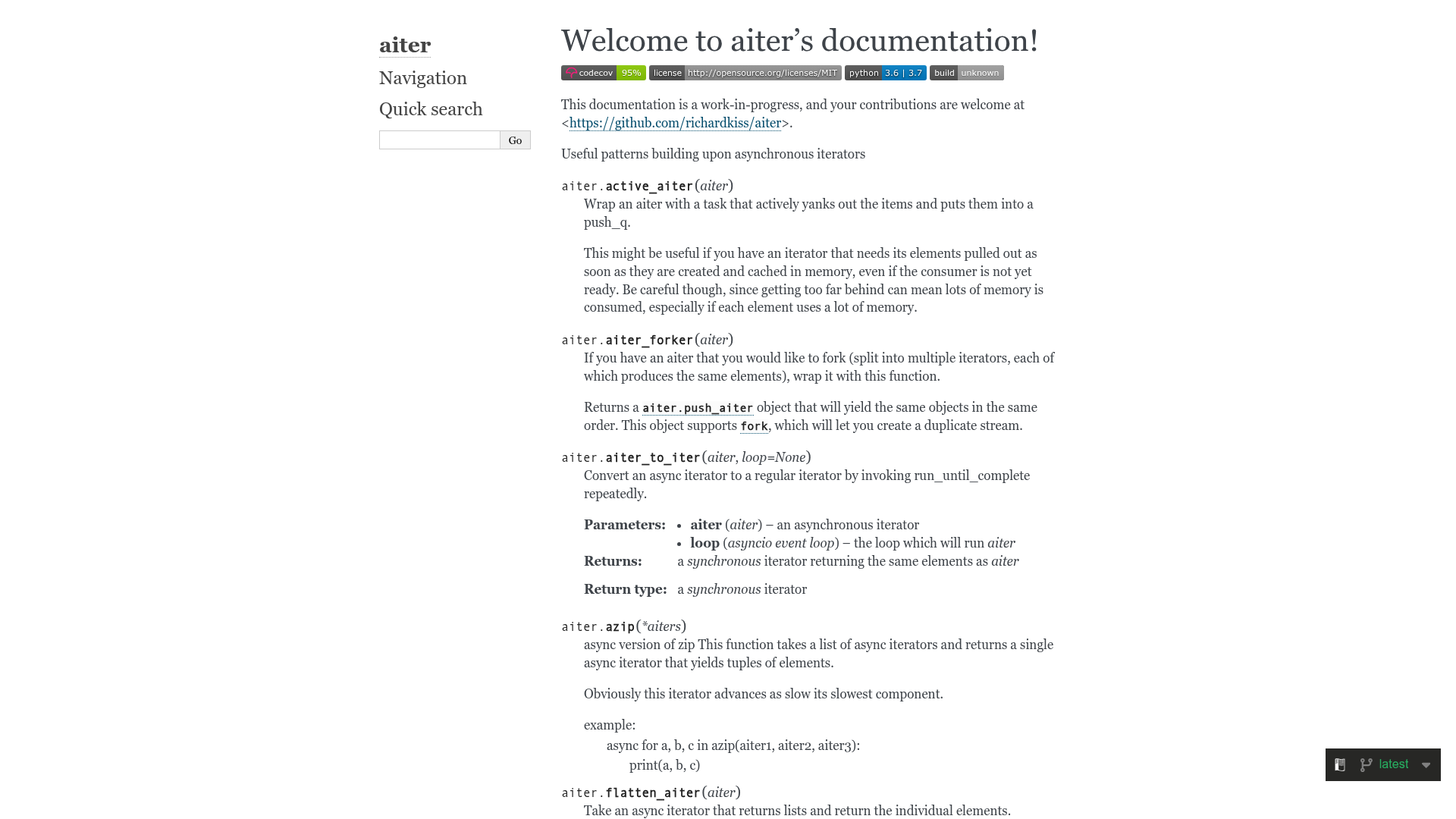
What it is
aiter is a Python library designed for developers working with asynchronous code. It offers a collection of utilities and patterns built around asynchronous iterators, simplifying complex async data processing tasks.
The library provides core functions like converting async iterators to regular ones, forking streams, actively preloading data, and merging multiple async iterators. It includes specialized classes such as push_aiter for creating push-based async iterators and gated_aiter for flow control.
Developers can use aiter to handle common async patterns like mapping, filtering, flattening, and joining data streams without blocking event loops. The push_aiter class allows creating iterators that can be fed data from external sources like hardware interrupts or callback functions.
This tool is particularly useful for Python developers building high-performance asynchronous applications, data processing pipelines, or event-driven systems that require efficient handling of streaming data.
This description was generated by AI from the site's public content and may contain errors.
What you can do there
- Read library documentation
- Learn async iterator patterns
- Access Python code utilities
- Contribute to open source project
- Implement async data processing
Who it's for
Python developers working with asynchronous programming and data streams
Frequently asked questions about aiter.readthedocs.io
›What is aiter?
aiter is a Python library that provides utilities and patterns for working with asynchronous iterators, making it easier to handle async data streams.
›How do I install aiter?
The documentation doesn't specify installation instructions, but typically Python libraries can be installed via pip from the Python Package Index.
›What are the main features of aiter?
Key features include async iterator forking, conversion between async and regular iterators, stream merging, mapping, filtering, and push-based async iterators.
›Who should use aiter?
Python developers working with asynchronous programming who need to process streaming data or implement complex async patterns would benefit from aiter.
›Is aiter compatible with standard Python async features?
Yes, aiter builds upon Python's standard asynchronous iterator pattern and works with asyncio event loops.
›Can I contribute to aiter?
Yes, the project welcomes contributions through its GitHub repository as mentioned in the documentation.
›Does aiter support multiple consumers for the same async iterator?
Yes, through the sharable_aiter class which allows multiple tasks to consume from the same async iterator safely.