
Agat
AGAT is a comprehensive toolkit for parsing, converting, and manipulating GTF and GFF genomic annotation files.
 ReadtheDocs
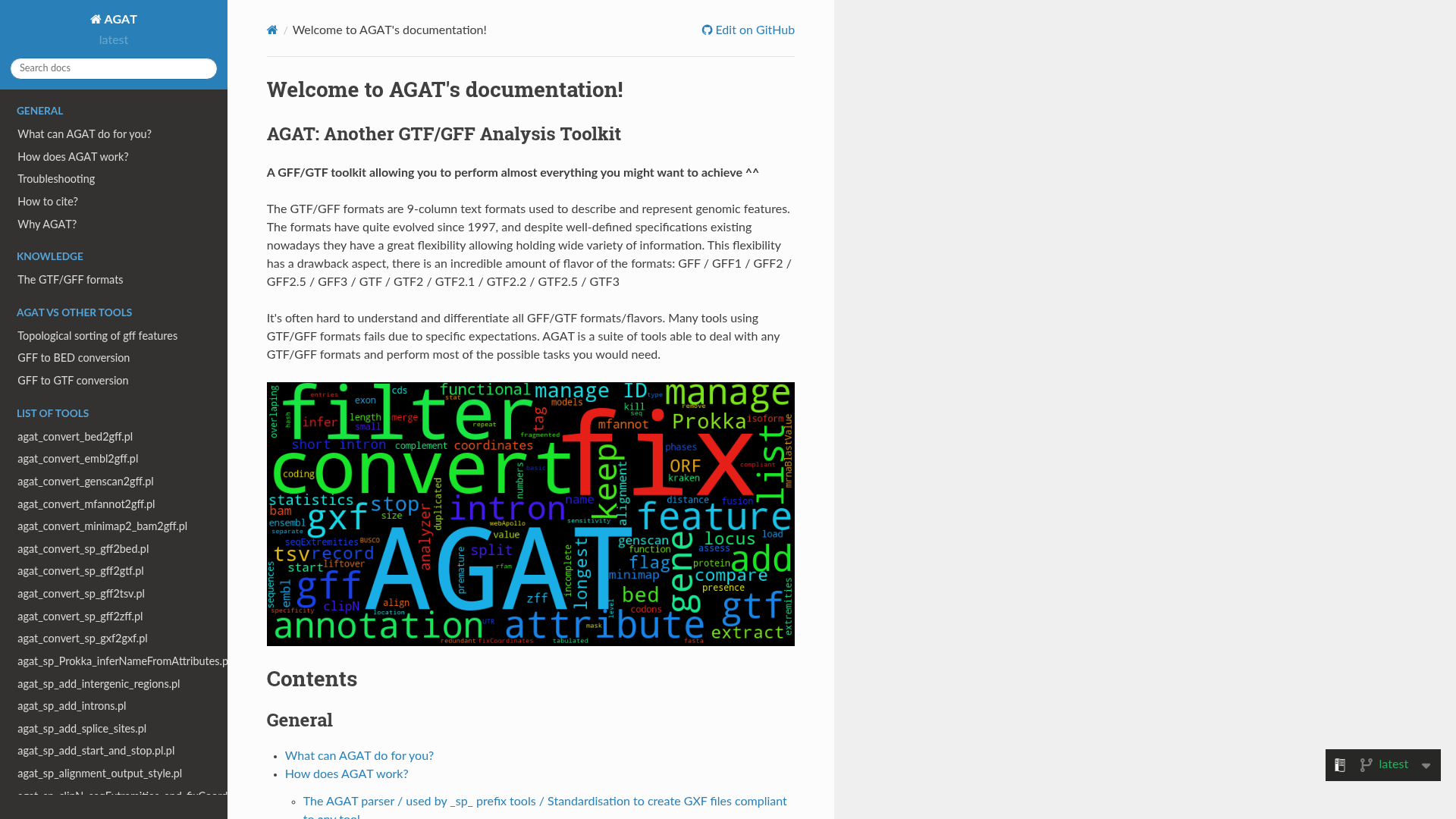
What it is
AGAT (Another GTF/GFF Analysis Toolkit) provides a suite of Perl scripts designed to handle the many flavors of GFF and GTF formats used in genomics. The toolkit addresses the lack of standardization across GFF/GTF versions by offering tools that can parse any variant and perform virtually any manipulation task researchers might need. From format conversion between GFF, GTF, BED, and other formats to feature filtering, attribute management, and quality control, AGAT covers the full lifecycle of annotation file processing.
The toolkit includes over 60 specialized scripts organized by function: conversion tools (agat_convert_*), spatial analysis tools (agat_sp_*), and sequence utilities (agat_sq_*). These tools handle tasks such as adding introns and UTRs, fixing CDS phases, merging annotations, filtering by ORF size or intron count, extracting sequences, and ensuring compatibility with downstream tools like Ensembl or WebApollo. The documentation provides detailed guides on topological sorting, format specifications, and troubleshooting common parsing issues.
AGAT serves bioinformaticians, genomic researchers, and data analysts who work with gene annotations from diverse sources. It is particularly valuable when integrating annotations from different pipelines or databases that produce slightly incompatible GFF/GTF output. The toolkit runs on the command line and can be incorporated into automated workflows for large-scale annotation processing.
Getting started involves installing the Perl dependencies and downloading the scripts from the GitHub repository. The ReadTheDocs documentation offers a structured table of contents with tutorials on general usage, format knowledge, tool comparisons, and a complete list of available tools with their specific functions. Each tool includes usage examples and parameter descriptions.
What makes AGAT notable is its comprehensive coverage of the GFF/GTF ecosystem. Rather than building custom parsers for each new format variation, researchers can rely on a maintained toolkit that handles edge cases, format conversion, and standardization automatically. The project is open source and actively developed, with a focus on practical solutions for real-world annotation challenges.
This description was generated by AI from the site's public content and may contain errors.
What you can do there
- Convert between GFF, GTF, BED, and other annotation formats
- Filter and manipulate genomic features by attributes, coordinates, or sequence properties
- Fix common annotation errors like phase issues, overlaps, and missing features
- Extract sequences and functional annotations from GFF/GTF files
- Standardize annotations for compatibility with Ensembl, WebApollo, and other tools
Who it's for
Bioinformaticians, genomic researchers, and data analysts working with gene annotation files
Frequently asked questions about agat.readthedocs.io
›What is AGAT used for?
AGAT is used for parsing, converting, validating, and manipulating GFF and GTF genomic annotation files across all format versions.
›Which file formats does AGAT support?
AGAT supports GFF, GFF1, GFF2, GFF2.5, GFF3, GTF, GTF1, GTF2, GTF2.1, GTF2.2, GTF2.5, GTF3, BED, EMBL, Genscan, and ZFF formats for input or output.
›How do I install AGAT?
AGAT is installed by downloading the Perl scripts from the GitHub repository and ensuring required Perl modules are available; detailed installation steps are in the documentation.
›Can AGAT fix common annotation errors?
Yes, AGAT includes tools to fix CDS phases, overlapping genes, fused genes, small exons, premature stop codons, and duplicated feature locations.
›Is AGAT suitable for large annotation files?
AGAT is designed for command-line use and can be integrated into pipelines for processing large-scale genomic annotations efficiently.
›How does AGAT handle different GFF/GTF flavors?
AGAT uses a flexible parser that standardizes diverse format variations into a common internal representation before performing operations or conversions.
›Where can I find examples for specific AGAT tools?
The ReadTheDocs documentation provides a complete list of tools with descriptions, and each tool typically includes usage examples when run with help flags.