
This
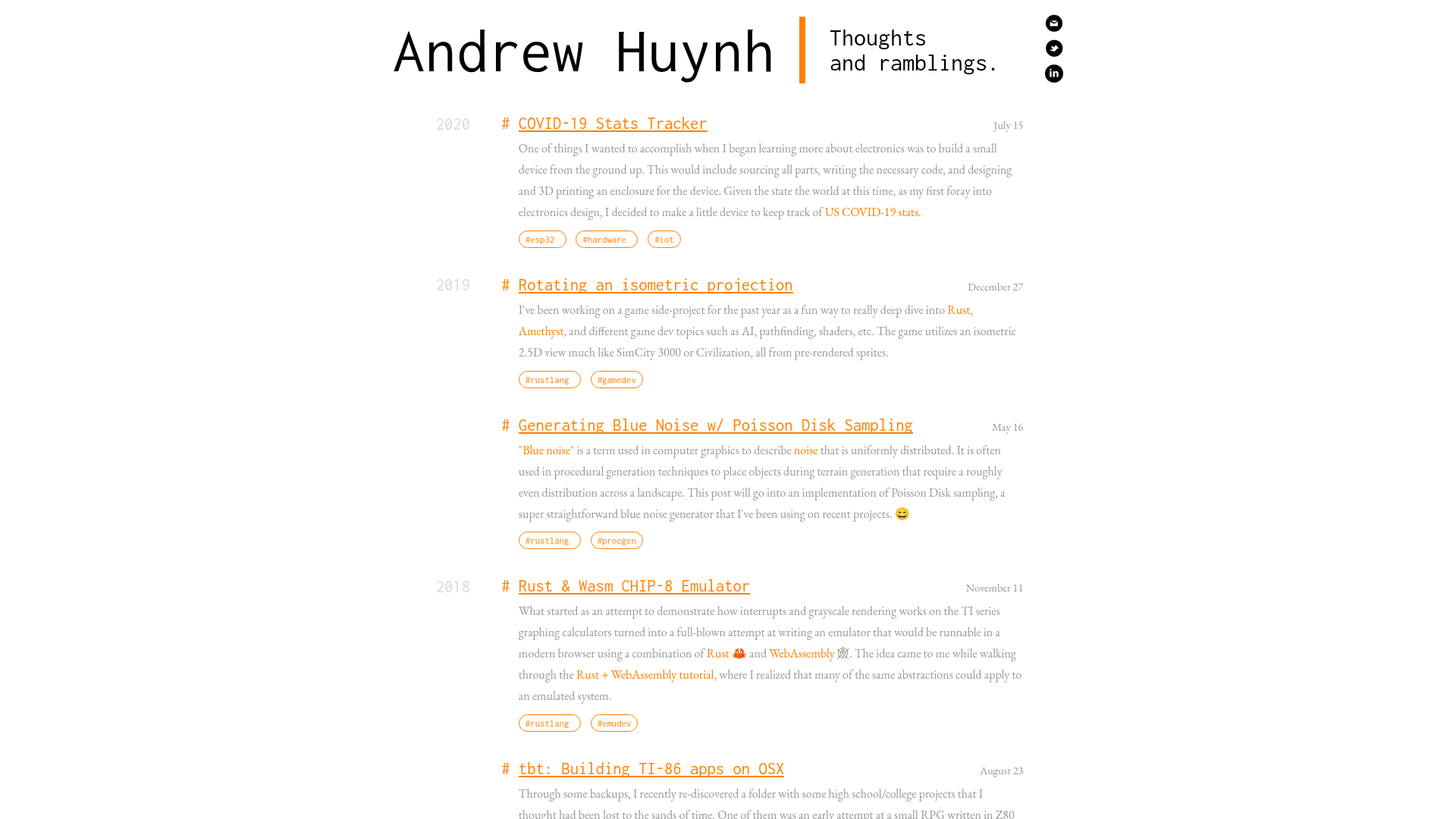
Andrew Huynh's personal blog featuring technical projects and tutorials on electronics, Rust programming, and game development.
 GitHub
What it is
This is the personal portfolio and technical blog of Andrew Huynh, a developer and electronics enthusiast. The site serves as a public notebook for his various projects, detailed write-ups, and learning journey.
The blog covers a wide range of topics, including building IoT devices like a US COVID-19 stats tracker with an ESP32, developing games and tools with the Rust programming language, and exploring computer graphics techniques such as isometric projection and blue noise generation.
Visitors can explore in-depth tutorials and project logs that document the entire process from concept to completion, including sourcing parts, writing code, and designing enclosures. It is an excellent resource for hobbyists, students, and other developers interested in hands-on electronics and modern systems programming.
The site is notable for its practical, code-heavy approach and its focus on open-source technologies like Rust and WebAssembly. It provides valuable insights for anyone looking to start similar projects in game development, emulator creation, or hardware prototyping.
This description was generated by AI from the site's public content and may contain errors.
What you can do there
- Read technical blog posts and project logs
- Learn about building IoT devices with ESP32
- Explore game development tutorials using Rust
- Find code examples for procedural generation
- Discover insights into emulator development
Who it's for
Developers, electronics hobbyists, students, and Rust programming enthusiasts interested in hands-on technical projects.
Frequently asked questions about a5huynh.github.io
›What kind of projects are featured on this blog?
The blog features a variety of technical projects, including a COVID-19 stats tracker built with an ESP32, a CHIP-8 emulator written in Rust and WebAssembly, and experiments with game development and procedural generation.
›Does the site provide tutorials for beginners?
Yes, the project logs often serve as detailed tutorials, covering the entire process from sourcing components and writing code to designing 3D-printed enclosures for electronics projects.
›What programming languages are used in the projects?
Rust is a primary language featured for projects like game development and emulator creation. Other technologies include WebAssembly, Arduino for hardware, and Z80 assembly for legacy projects.
›Can I learn about game development on this site?
Absolutely. The blog includes content on isometric 2.5D game development, AI, pathfinding, shaders, and procedural generation techniques like Poisson Disk sampling for blue noise.
›Is the code for these projects open source?
While not explicitly stated, the detailed write-ups and technical explanations suggest a focus on sharing knowledge and methodologies common in the open-source community.
›Does the site cover any data science topics?
Yes, one project involves a text analysis of U.S. bills, demonstrating an application of Python for data science and gathering publicly available data for analysis.